In a directive whose logic is not always apparent, the Transportation Security Administration has spelled out what airline passengers can carry on board with them, what must be placed in checked luggage, and what can’t go on the plane at all. Knives must be checked but knitting needles and corkscrews are allowed in the cabin. Up to four ounces of eye drops can be carried aboard, with fingers crossed that multiple terrorists won’t combine their allotments to exceed the limit. Laptops, digital cameras, mobile phones and other electronic devices are permitted, so never mind any warnings you’ve heard that they could be used to trigger a bomb. The bomb ingredients themselves, notably liquid explosives, will be kept out of the cabin by a ban on liquids, gels and lotions, except for small amounts of baby formula and medications.
Perhaps Not as Fun Today: 2006 Wisconsin Ironman Underway
These 2006 ironman competitors from Kansas City took in the Farmer’s Market Saturday.
Photos and video from the 2005 Wisconsin Ironman are here.
2006 Badger Attire
 |
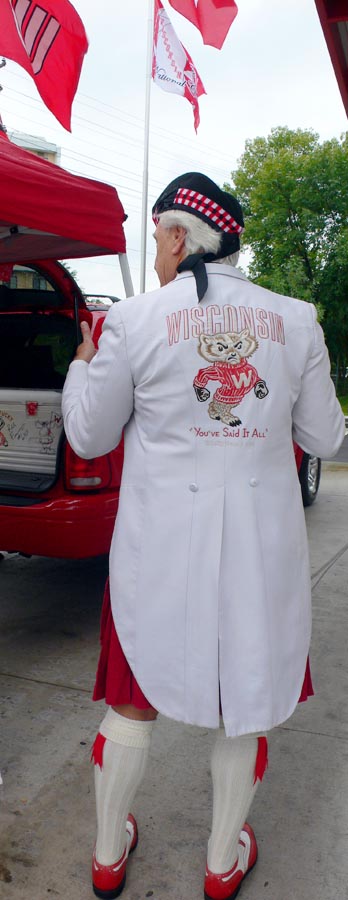 |
This gentleman mentioned that he was married at Camp Randall 15 years ago today (Saturday). The shoes were “custom made” by Port Washington’s Allen Edmonds (via John Stollenwerk). Quite a change from my red and white bib overalls of some years ago.
2006 Young Innovators Under 35
Since 1999, the editors of Technology Review have honored the young innovators whose inventions and research we find most exciting; today that collection is the TR35, a list of technologists and scientists, all under the age of 35. Their work–spanning medicine, computing, communications, electronics, nanotechnology, and more–is changing our world.
On Ford
“The production of the new Ford tractor would not involve stockholders, directors, absentee owners or parasites.” — Henry Ford, quoted by the Dearborn Independent, 1915
Ethanol, Ethanol Everywhere, Time to Stop and Think
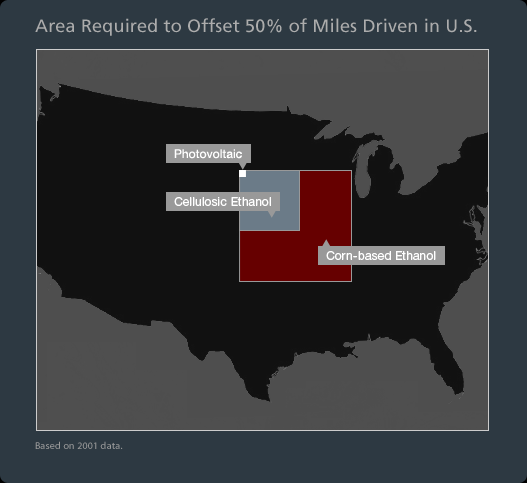
Ethanol (a.k.a. alcohol) will certainly grow as a business and serve as a partial solution to our energy problem, particularly given that it is now taking the place of the gasoline additive MTBE. However, even if large-scale cellulosic ethanol technology is perfected, I don’t believe it can become the primary solution to the world’s energy needs.
The often-used example of Brazil does not apply to most parts of the world and may not even apply to Brazil if they see high economic growth with its attendant energy demands. Brazil is in the tropics with an all year round growing season and an enormous amount of arable land relative to its population food requirements and the number of cars on the road.
In contrast, domestic ethanol as the primary solution will definitely not work for the world’s most populous countries, such as Japan, China, India, Pakistan, Indonesia, etc. Those countries are either breaking even on domestic food production or are net importers. If you argue that ethanol is to be grown elsewhere and shipped, where are the vast tracts of unused arable land? And, bear in mind, the calories burned by two ton cars are much greater than those burned by 170 pound humans.
Farmer’s Market Flowers

More on the Dane County Farmer’s Market.
A Gray Labor Day on State Street

A view from the Overture Center.
Sort of a quintessential Madison scene: A Volve, The Orpheum, Capitol, Bus Shelter and a chain restaurant.
Meanwhile, in Tibet…..
World’s Largest Oil Field in…. Colorado
Underneath the high, scrub-covered rangeland of northwest Colorado is the world’s biggest oil field. Getting the oil out of the ground, however, is one of the world’s biggest headaches.
The area’s deposits of oil shale are believed to be larger than all the oil reserves of the Middle East. But past attempts to get at this oil locked in tarry rock have cost billions of dollars and raised the prospect of strip-mining large areas of the Rocky Mountain West.
Now, as the federal government makes another push to develop oil shale, Shell and other companies say they have developed techniques that may extract this treasure with much less environmental impact.
What goes around, comes around. The Western Slope oil shale project collapsed in the mid 1980’s – creating a deep Colorado recession.
UW’s Charles Franklin Launches Pollster.com
Pollster.com is the new home of Mystery Pollster, the blog that has labored to demystify the art and science of political polling for the last two years, but it is also much more. Our Polls feature will take you to pages with complete listings of all the public polls available for the most competitive races for Senate and Governor with an important bonus: Interactive charts that show you how the poll results compare to each other as well as trends over time.
Before you dive into the data pages, let me tell you about the incredible team behind Pollster.com. Regular MP readers will notice a similarity between our charts and the stellar graphics produced by our friend Charles Franklin, professor of Political Science at the University of Wisconsin and creator of the blog PoliticalArithmetik. Franklin is a central part of the Pollster team and will also provide frequent commentary here on the Pollster blog as well as lead in the development of new ways to visualize results graphically.
By the way, today also marks the debut of our strategic partnership with Slate Magazine. We have worked with Slate to create an Election Scorecard that will track the daily trends in the race to control the U.S. Senate, the House of Representatives and key Governorships in 2006. With the help of Charles Franklin, I will write a daily update for Slate through Election Day on where those races stand. Links to that update will also appear here daily.
More about Franklin:
Charles Franklin is the co-developer of Pollster.com. He will provide frequent commentary and lead in the development of new ways to visualze polling results graphically. Franklin is the creator of PoliticalArithmetik (“Where numbers and politics meet”) and a professor of political science at the University of Wisconsin, Madison. He specializes in the statistical analysis of polling and election results.