Cheese championships are hardly a spectator sport, but cheese-lovers will have a unique opportunity to observe the 2006 World Championship Cheese Contest right here in Madison. Free and open to the public, the contest is slated to take place at the Monona Terrace Convention Center on March 21-23.
While UW-Madison scientists don’t usually compete, they do influence the contest’s outcome. This year, for instance, Mark Johnson, a scientist at UW-Madison’s Wisconsin Center for Dairy Research will join an international panel of judges that will include cheese connoisseurs from France, Japan, the Netherlands and South Africa. Another judge on the 15-member panel will be a Puerto Rican, Leyda Ponce de Leon, who earned a doctoral degree in food science at UW-Madison in 1999.
A Delightful Few Days Skiing at Wisconsin’s Whitecap Mountains
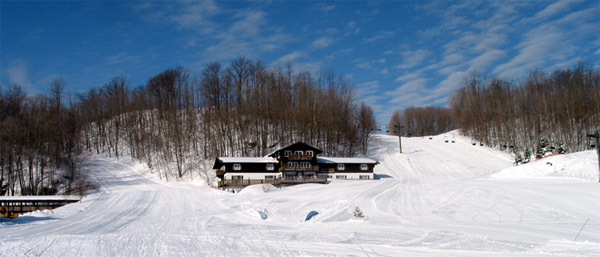
A March visit to Whitecap Mountain
Spring break 2006 presented an opportunity to check out a ski area that was within a reasonable distance (avoid flights) and promised a decent amount of snow. I surfed the web last week seeking such a destination and found Whitecap, a resort that Ski Magazine has posted favorable words on the years. Those reviews, along with a very attractive package ($199 per person for 3 nights, 3 day lift tickets, 2 dinners, 3 breakfast meals, rentals and a one hour daily group lesson) sealed the deal.
Fight Against Farm Subsidies
Scott Kilman and Roger Thurow:
A movement to uproot crop subsidies, which have been worth nearly $600 billion to U.S. farmers over the decades, is gaining ground in some unlikely places — including down on the farm.
In Iowa, one of the most heavily subsidized states, a Republican running to be state agriculture secretary is telling big farmers they should get smaller checks. Mark W. Leonard, who collects subsidies himself and campaigns in a white cowboy hat, told a room full of farmers recently that federal payments spur overproduction, which depresses prices for poor growers overseas.
“From a Christian standpoint, what it is doing to Africa tugs at your heartstrings,” Mr. Leonard told them. Last year, he helped humanitarian group Oxfam International in its anti-subsidy campaign by escorting a cotton farmer from Mali to church gatherings near his farm in Holstein.
Why Don’t More Businesses Use Prediction Markets?
Last week in The New York Times (TimesSelect), Joseph Nocera quoted Robin Hanson as saying private businesses had not made a breakthrough with the use of idea futures. It seems natural to let your employees bet on future business conditions, the success of product lines, or broader questions of corporate strategy. Microsoft and Google and a few other companies have played with the idea, but it does not (yet?) seem to be taking off. Why not?
- Prediction markets threaten the hierarchical control of top managers. It would become too obvious that most managers are idiots, unable to predict the future.
- Prediction markets make a big chunk of the bettors into “losers.” Yet within a company morale is all-important. Businesses proceed by soliciting feedback, and by reshaping their plans to pretend that everyone is on board and has an ego stake in the final outcome. Prediction markets make this coordination more difficult. Once people make bets, they start rooting for their bet to win and for the other bet to lose. They move away from maximizing the value of the firm and develop an oppositional mentality vis-a-vis other employees. Furthermore it is disruptive to have a running tally on who are the winners and losers each day.
Super Target Plans
Madison Alder Zach Brandon posts the latest development plans for Fitchburg’s Super Target.
Gillmor on McClatchy’s Knight Ridder Deal
Former SJ Merc (a Knight Ridder paper) writer Dan Gillmor:
I hope McClatchy’s obviously sound instincts, in business and journalism, continue with the enlarged company. Having met and chatted with some of their senior folks, and admiring the journalists I know there, I’m fairly confident that McClatchy will do well. But it faces the same economic pressures that forced Knight Ridder to cave in to speculators and other investors for whom journalism is an abstraction — an unfortunate cost of being in business — and certainly not a priority.
I’m not nostalgic for what many newspapers have become: empty journalistic vessels working mostly for the advertisers and shareholders, only vaguely interested in serving the people of their communities. But when newspapers do their best, they are vital parts of those communities, and we need quality journalism more than ever.
Terry Heaton has more in a related post.
A380 Super-Jumbo Jet: 7 Minute Video of the 12 Month Assembly Process
I doubt that flying with 550 to 900 people packed into a large plane will be all that enjoyable. The plane, is nevertheless, being built and will fly late this year or early next. The brief assembly video clip is rather interesting.
Flying Without an ID
According to the TSA, in the 9th Circuit Case of John Gilmore, you are allowed to fly without showing ID — you’ll just have to submit yourself to secondary screening.
The Identity Project wants you to try it out. If you have time, try to fly without showing ID.
Lawmaker’s Use of Corporate Jets
Senator Barack Obama flew at least nine times on corporate jets last year, traveling to fund-raisers in New York and San Francisco, home to Chicago and to Rosa Parks’s funeral in Detroit. Each time, he reimbursed the plane’s owners at first-class rates, as Senate rules require.
But Mr. Obama, freshman Democrat from Illinois, felt queasy about this perk of Senate life, so he said he gave it up.
“It’s not only a perk,” Senator Russell D. Feingold, Democrat of Wisconsin, said, “but a serious abuse that should be stopped.”
Mr. Feingold said he always flew on commercial planes.
Details on Wisconsin’s corporate travel list is Wisconsin’s own Jim Sensenbrenner. Others flying via corporate jet include:
- David Obey #73: $73,299
- Paul Ryan: #136 $48,295
- Tammy Baldwin #137 $48,173
- Ron Kind: #249 $27,906
GM’s Slide: Bosses Misjudged New Urban Tastes
Lee Hawkins, Jr (a writer who used to work in Madison and Milwaukee):
In December, General Motors Corp. ran a series of ads across the U.S. showing Cadillacs being driven in snow. The decision to do so was made by the giant car maker’s executives in Detroit, where on Christmas Day, temperatures hovered just above freezing.
The ads also ran in Miami, a vibrant car market where GM has bombed for the past 15 years. As Christmas dawned, temperatures there started climbing into the high 70s.
GM is struggling under a financial burden created by monumental pension and health-care obligations. But it’s also having a hard time persuading Americans to buy its cars. One reason: GM’s cumbersome and unresponsive bureaucracy, the one that ran the snow ads in Miami, has for years failed to connect with the tastes and expectations of consumers outside the company’s Midwestern base.
Hawkins does a nice job digging into this issue with examples from mid level GM employees. GM has a large assembly facility in nearby Janesville.