Calculated Risk:
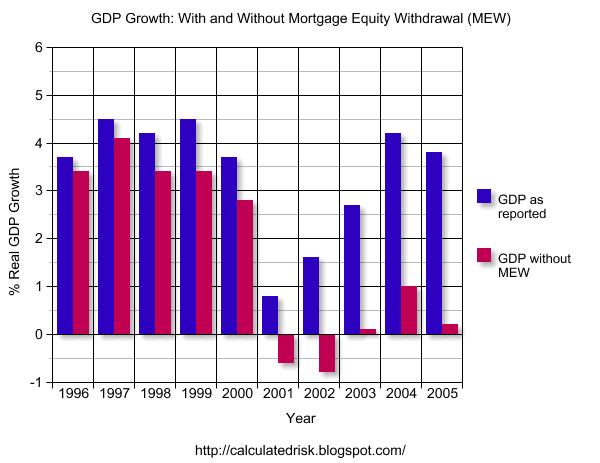
The recent Flow of Funds report showed that household mortgages increased a record $289.5 Billion in Q3 2005. Using a simple formulation for Mortgage Equity Withdrawal (MEW), MEW was $171 Billion in Q3.
Calculated Risk:
The recent Flow of Funds report showed that household mortgages increased a record $289.5 Billion in Q3 2005. Using a simple formulation for Mortgage Equity Withdrawal (MEW), MEW was $171 Billion in Q3.
Former Wisconsin Gov. Tommy Thompson seems to be in no rush to be implanted with an ID chip, as he told interviewers he would in July.
A TV network recently interviewed Thompson, a former U.S. secretary of health and human services, after he was named to the board of directors of VeriChip, which sells a radio-frequency ID chip that can be implanted under the skin. The chips alarms privacy advocates who worry whether government and corporations will abuse the technology.
Vishal Agrawal, Paul D. Mango, and Kimberly O. Packard:
Eager to curb the rising cost of health care, many US insurers and employers are considering consumer-directed health plans (CDHPs), which are designed to lower costs by giving consumers more responsibility for managing their own health care spending.1 Indeed, a survey indicates that this interest is more than justified. We found that the plans encourage value-conscious behavior, increase the consumers’ level of engagement with their well-being, and may even promote behavior that leads to better long-term health.
In March 2005 we surveyed 2,500 consumers, 1,000 of whom had been enrolled in a CDHP for at least one year.2 We also conducted extensive interviews with 25 of these CDHP consumers and with seven benefits managers who administer the plans.3 Our goal was to learn how consumers’ behavior changes when they become responsible for a greater share of their health care costs.
Jeff Jarvis and others have been discussing the analogy of newspapers as mainframe computers. In essence, they are analagous: mainframes represented centralized processing, distribution and control. PC’s came along and blew that up. Mainframes still exist, but are being replaced by clusters of smaller, generally clustered linux computers. The migration continues to ever smaller network devices.
There is another analogy: Newspapers as legacy media. I recall discussing this last fall with Jay Rosen at Bloggercon. The software business uses the term legacy to describe mothballed code, or something that is no longer updated. Generally, this term is used when a customer is moving from software product/platform a to product/platform b (DOS to Windows, Unix to Linux, terminals to client/server to web services).
There will always be journalism, some great, some not so great. It will simply be delivered many different ways.
Just two months after it pulled the plug on the massive Ford Excursion, the Detroit News said the automaker is preparing to unveil a vehicle tentatively called the “Ford Everest.”
“Excursion was just too much. It went overboard,” Joe Langley, and analyst with CSM Worldwide, told the newspaper. “But there’s still a market for a (jumbo) SUV.”
The Excursion, launched in 2000, was quickly dubbed the Ford Valdez by critics; and Ford (down $0.02 to $8.16, Research) ended production earlier this year as gas prices topped $3 a gallon.
What about future trends, asked Sahlman. Many venture capitalists made money in enterprise software, until the space was saturated. Will venture capitalists have an impact in fields relating to healthcare, education, and the environment—all areas that show a great demand for new solutions?
“Clean energy is big on the West Coast,” said Reiss. “Venture capitalists haven’t traditionally invested in those areas that you mentioned . . . but given the amount of money that’s in the business, somebody is going to try, and somebody will be right.”
Podcasts go mainstream – fast:
Is this the right move for you? If so, what does it take to be a successful RIA? What challenges lie ahead? And what steps should you take to prepare for a seamless transition to running your own firm? Listen to this program to gain answers to these and many more questions about what it takes to establish an RIA.
Props to TDS for taking the plunge locally. TDS’s fibre to the home service supports 10mbps down and 4mpbs upstream. Not a bad start. Jeff Richgels . Bundles range from $64 to $89/month.
David Eisenberg notes the need for net neutrality amongst the telco’s.
These are the ideas that, for better and worse, helped make 2005 what it was. You’ll find entries that address momentous developments in Iraq (“The Totally Religious, Absolutely Democratic Constitution”) as well as less conspicuous, more ghoulish occurrences in Pittsburgh (“Zombie Dogs”). There are ideas that may inspire (“The Laptop That Will Save the World”), that may turn your stomach (“In Vitro Meat”), that may arouse partisan passions (“Republican Elitism”) and that may solve age-old mysteries (“Why Popcorn Doesn’t Pop”). Some mysteries, of course, still remain. For instance, we do not yet have an entirely satisfying explanation for how Mark Cuban, the outspoken Internet mogul and N.B.A. owner, came to be connected with three of the year’s most notable ideas (“Collapsing the Distribution Window,” “Scientific Free-Throw Distraction” and “Splogs”). That was just one surprising discovery we made in the course of assembling the issue. In the pages that follow, we’re sure you’ll make your own. Go to the Issue
A new study suggests the Internet is used as a resource for influencing participation in civic affairs more often than general media and face-to-face communication.
Conducted by University of Wisconsin journalism and mass communication professor Dhavan Shah, the study tested the change in media exposure over time. Shah’s work analyzed various forms of data conducted before, during and after the 2000 presidential election.
