 |
Dave Stark, a friend and long time client has published the first of what will be a quarterly look at the Madison area real estate market [1.2MB PDF]:
|
Clostridium difficile: Stalking the World
Ordinarily, the human colon harbours very few of the rod-shaped bacteria that cause Clostridium difficile associated disease or CDAD. But the guts of those people who are given antibiotics to prevent or treat infection during a stay in hospital are different. Antibiotics may rid the colon not only of harmful bacteria, but also of the beneficial ones that normally live there. This, in turn, can give C. difficile the chance to take hold.
Rates of the disease among patients in, or recently discharged from, American short-stay hospitals seem to have doubled between 2000 and 2003 and risen another 25% in 2004, the most recent year for which estimates are available. That translates into at least 225,000 new cases a year, according to the Centres for Disease Control, a government agency based in Atlanta, Georgia. As this number does not capture all of America’s hospitals and ignores its nursing homes, the real figure is probably at least 500,000 cases a year.
The full extent of the illness is unclear because American hospitals are not required to report it. Even when someone with the disease dies, his death certificate may not say he had it. Whatever the true numbers, about 20% of people infected have repeated bouts of the illness and some 1-2% of the stricken die; chiefly, but not exclusively, the victims are elderly people who are already in frail health.
Greenleaf: A Local Food Exchange
When a farmer walked into Whole Foods wanting to sell a huge sack of morels, store employee Heather Hilleren watched a futile effort unfold.
The farmer didn’t have vendor credentials, and it would have taken two weeks to get them. By then, the freshly picked morels would have spoiled.
Southwest Utah Trip: Day 1, SLC to Torrey
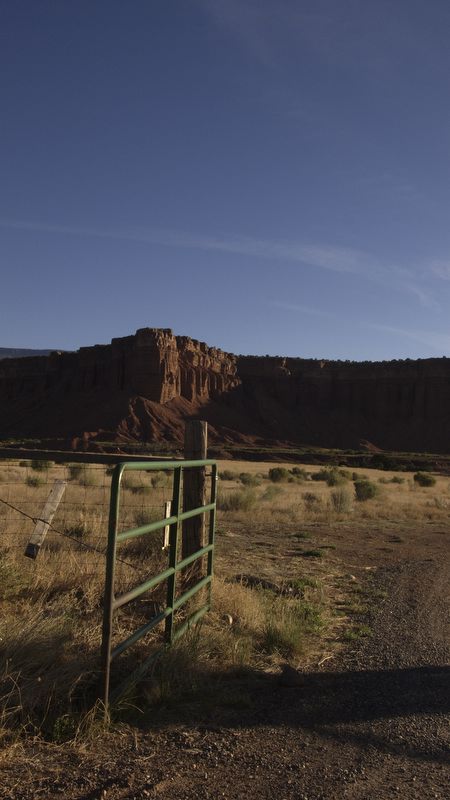
Photos from Day 1 of our Southwest Utah trip: SLC to Torrey.
Government Wants Internet Firms to Keep Online Activity Records for Two Years
Gonzales and Mueller asked Google Inc., Time Warner Inc.’s AOL and other companies to preserve the data at a May 26 meeting, citing their value to investigations into child-pornography distribution and terrorism. Internet companies typically keep customer histories for only a few days or weeks.
The Justice Department said Thursday that it was not seeking to have e-mail content archived, just information about the websites people visit and those with whom they correspond.
Beyond law enforcement, though, the trove also could be available to lawyers arguing civil lawsuits — including divorce cases and suits against people suspected of swapping copyrighted movie and music files online. Privacy advocates fear the user histories could be exploited by criminal investigators conducting inappropriate exploration or pursuing minor cases.
“This is not simply limited to kiddie porn or terrorism. It’s a real break with precedent,” said Marc Rotenberg, executive director of the nonprofit Electronic Privacy Information Center. “Data retention is open-ended. The government is saying, ‘Keep everything about everyone and we’ll sort it out later.’ ”
Google vs Microsoft
I’ve heard all sorts of chatter about the Google foray into spreadsheets, and none of it resonates with me. Here are 3 key aspects of this worth thinking about:
1. Strategically, Google is shooting at half of the Microsoft franchise
Microsoft, despite alot of hoopla you have heard about all its other product offerings, makes the vast lion’s share of its money via its Operating System and via Office. Nothing else it does is generates nearly the profitable cash flow as those two money printing presses do.
Think long term strategy: From a military perspective, Google is opening a second front in the war Microsoft launched against them. You want to come after our core busines? Allow us to return the favor.
BABY LEFT FOR DEAD IS ALL GROWN UP
The temperature outside on the night of Dec. 30, 1987, was 45 and dropping. Cold for most anyone, but perilous for a newborn baby girl wrapped in a towel and stuffed in a brown paper bag like trash.
She probably wasn’t meant to be found alive.
When Steve Gibbons, a California Highway Patrol officer, pulled off Interstate 280 to stop and stretch his legs, she was just hours old. Her temperature had plummeted to a dangerous 90 degrees. If she had been there much longer, she would have died near the intersection of Cañada and Edgewood roads in Redwood City.
But Gibbons heard the baby’s cry.
Eyes in the West Are on Federal Land Sale
Its mild climate, stunning scenery and proximity to several national parks have helped make Washington County one of the five fastest-growing counties in the nation. But like many rural Western counties, it has little room to expand: 87% of its land is owned by the federal government.
Now, Utah’s congressional delegation has a plan to remedy the problem, one that is being closely watched by nearly a dozen Western counties with similar growing pains. The plan is also being scrutinized by conservationists who warn that it would set a dangerous precedent, making thousands of acres of public land available for private development as well as offering a windfall for local agencies and special deals for politically influential officials and property owners.
Lower Calf Creek Waterfall
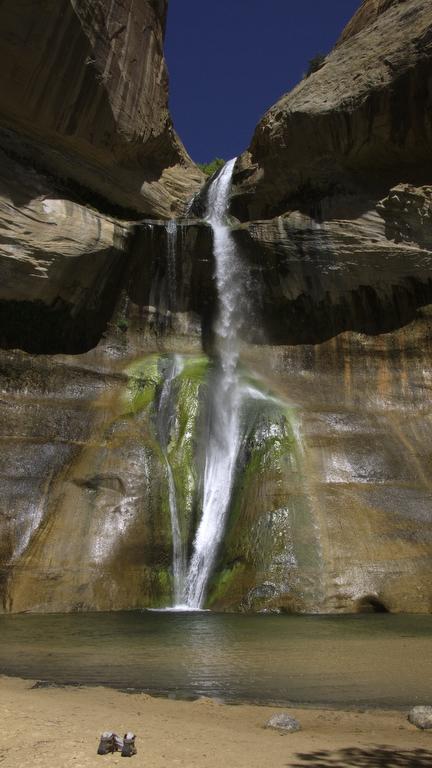
N37? 49.753′ W 111? 25.291′
Top 10 Photographs Ever Made
Mike Johnston has been posting his choices for the top 10 photographs ever made. Interesting