For most of the 92 years since the federal income tax was established, the states followed Washington’s lead concerning how to tax people and businesses. That ended in 1981, when 21 states adopted their own rules on depreciation in response to a Reagan tax cut. Many of these renegades — California being a notable exception — later went back to a more uniform tax code. But the precedent was set. When Congress began slashing federal rates in 2001, many cash-strapped state legislatures opted to go their own way once again.
Tax experts call this “decoupling.” That’s a jargony name for a practice that can — and most likely will — cause you to run screaming to your accountant. “It is a zoo,” says Jere Doyle, an estate-planning and tax expert in Mellon Financial’s Boston office. “Everybody thinks ‘federal, federal, federal,’ and assumes that the same rules will apply at the state levels. But they do not
Yearly Archives: 2005
Steve Jobs Odyssey
A transcript of Steve Jobs’ Stanford Commencement Speech, given this past weekend.
Errol Morris Interview
Errol Morris discusses advertising and his recent documentary, the Fog of War in this interview.
HuffPost: But there’s certainly been criticism, especially with McNamara, that you may not have pushed hard enough.
Morris: In truth, I wish I had done something like that when he went on and on about the Gulf of Tonkin incidents. Didn’t we try to provoke them? A number of people have criticized me and the movie for giving a false impression or what they consider to be a false impression of those events.
HuffPost: You and Eric Alterman had a conflict about this issue in the film, about footage that may or may have existed showing McNamara discussing secret intercepts regarding the Gulf of Tonkin.
Morris: Right. Alterman just engaged in hand-waving. It’s sort of, “You’re not a historian so why should I listen to you?” I’m not a big enthusiast of that kind of argument. It’s like in Mr. Death, Fred Leuchter, the Holocaust denier, has a degree from BU in history. Does that mean that his historical views are more valid? No.
I’m always puzzled when people ask if a film is true or false. Fog of War, true or false? Fahrenheit 911, true or false? Sorrow and Pity, true or false? Isn’t what interests us about documentary film, that there is a claim that relates to the world and hence does have truth value? You can think about things that are said by people and think, is this true, is this false, what is this?
Microsoft Censoring Chinese Blogs
BBC:
Weblog entries on some parts of Microsoft’s MSN site in China using words such as “freedom”, “democracy” and “demonstration” are being blocked.
Chinese bloggers already face strict controls and must register their online journal with Chinese authorities.
Microsoft said the company abided by the laws, regulations and norms of each country in which it operates.
Rebecca MacKinnon has more
Edwards in Wausau
Former Democratic VP Nominee John Edwards spoke to a number of David Obey’s supports at a Wausau Fund Raiser Sunday. WisPolitics’ J.S. Decker has more.
The Illiterate Surgeon
Kristof posts a moving story from Addis Ababa. Check out the photos & video.
BBC Motion Gallery
Some fabulous video clips in the BBC Motion Gallery.
Hunter S. Thompson Tribute Beer
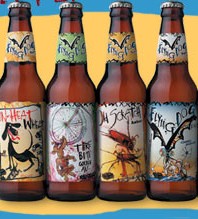
“Colorado’s Flying Dog Ales is making a tribute beer to Hunter S. Thompson. Ralph Steadman, who did the artwork for Hunter’s books, is designing a unique four pack case for this limited edition brew. They are also going to donate some of the profits towards the giant Gonzo fist to be built in Aspen.” via Cory Doctorow
Schneier Disects the TSA’s “Trusted Traveler Program”
I’ve already written about what a bad idea trusted traveler programs are. The basic security intuition is that when you create two paths through security — an easy path and a hard path — you invite the bad guys to take the easy path. So the security of the sort process must make up for the security lost in the sorting. Trusted traveler fails this test; there are so many ways for the terrorists to get trusted traveler cards that the system makes it too easy for them to avoid the hard path through security.
Miller on DRM Lock-in
Ernest Miller on Apple & Microsoft DRM (Digital Restrictions Management) Lock-in:
Look at it from Microsoft’s point of view. Every song you purchase from iTunes with Apple’s proprietary, DMCA-protected DRM is one more bit of lock-in to Apple. When you’ve got a hundred or two hundred or more of your favorite (let’s face it, you buy your favorites first) songs in iTunes format, you’ve got some significant lock-in in the form of very high switching costs. Just the way Steve Jobs likes it.
And that lock-in is growing at a rate of millions of songs every month.
Very useful post, Ernie!