Government Weather Data: Must We Pay Twice?

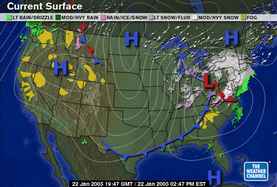
James Fallows takes a look at the intersection of public (taxpayer funded) and private (business) interests, specifically, weather data that we’ve already paid for. Some businesses, who have made a living recycling that data, would like to continue their gatekeeper role. [We have examples of this in Madison. Access Dane offers “subscription” access to data that we’ve already paid for]. Here’s a clip from Fallows article. Read it all.

some of the most significant innovations have been made where public and private efforts touch. In its first term, the Bush team made a few important pro-technology choices. Over the next year it will signal whether it intends to stand by them.
There is a long historical background to the administration’s choices, plus a variety of recent shifts and circumstances. The history stretches to the early days of the republic, and the idea that government-sponsored research in science and technology could bolster private business growth. Progress in farming, led by the land-grant universities, demonstrated this concept in the 19th century. Sputnik-era science, culminating in the work that led to the Internet, did the same in the 20th century.

Open source weather is available here.
Create your own weather site using the NOAA’s xml web service.

Lafayette, LA Pro Fiber Blog

Mike Stagg:

“Whoever builds a fiber to the home network is going to have a monopoly – whoever builds it. As a practical matter, I am opposed to monopolies. But I would much rather have a monopoly that I can touch and see and feel and affect, which is [Lafayette, Louisiana municipal utility operator] LUS.”

Via David Isenberg
Madison should be thinking like this as well.

Does Not Compute: Technology Implementations….

Nicholas G. Carr continues his analysis of failed software projects. Carr wonders if we should scale back our technology expectations:

Equally important, they stopped trying to be creative. Rather than try to customize their software, they began looking for cheaper, off-the-shelf programs that would get the job done with a minimum of fuss. When necessary, they changed their own procedures to fit the available software. Old, generic technology may not be glamorous, but it has an important advantage: it works.
It may well turn out that the F.B.I.’s biggest problem was its desire to be innovative – to build a new wheel rather than use an old one within easy reach. When it comes to developing software today, innovation should be a last resort, not a first instinct.

Carr is mistaken in telling technology drivers to slow down with respect to innovation. The real question is whether or not top management has made the commitment to align their business processes with the technology (and provide leadership when tough decisions must be made). Carr, of course does not mention the many successful technology innovations we take for granted today, such as

  • Cell Phones
  • The Internet
  • Fast payment processing (credit cards)
  • Travel reservation systems

We take these innovations for granted, but each one required risk, leadership, mistakes and a willingness to make it work. There are no shortcuts. More on Nicholas G. Carr.

AT&T’s CTO recognizes what is required to succeed:

“The biggest challenge is not the technology,” he said, “but being able to change the culture.”

Saturday Snow Storm: Music to Shovel…. or a Snowstorm Playlist :)


A few selections from the music my ipod shuffled to while shoveling earlier today (Madison received about 8″ of snow).

Ironically, I received an email this morning from Tony Novak-Clifford, host of Manao Radio’s Sunday Mornings “Sunday Solstice” program as well as Monday & Tuesday morning’s “Academy of Errors”. Tony’s email mentioned a rainy Maui Saturday morning.

UPDATE:
Dave sends a link from Boston, which will soon have quite a bit of snow. More Madison Photos: Gala & James Gardner catch snowplow stuck in a snowbank. Ann Althouse posts two early morning photos. More later

Sony admits their attempt to lock us in a box failed: DRM

Sony’s non mp3 support in it’s portable audio devices was a mistake, they now admit. Yuri Kageyama:

Ken Kutaragi, president of Sony Computer Entertainment, said he and other Sony employees had been frustrated for years with management’s reluctance to introduce products like Apple’s iPod, mainly because the Sony had music and movie units that were worried about content rights.

But Sony’s divisions were finally beginning to work together and share a common agenda, Mr Kutaragi said at the Foreign Correspondents Club in Tokyo.

Well, duh. Most of these DRM (Digital Restrictions Management) schemes will fail. Slashdot discussion.

DRM is not binary

Tristan Louis takes a useful look at DRM (digital rights/restrictions management):

What I am trying to highlight is that while proponents and opponents of DRM solutions both see the world in black and white, they may want to start a dialogue and realize that there’s a lot of gray areas out there.

Via Doc Searls.