This is one of those “products” that seems to be an answer in search of a question. Here come the mopisodes – one minute episodes targetted at cell phone users. Via Slashdot.
BT to offer Free Long Distance with Broadband Connection
British Telecom is offering free long distance service to new broadband subscribers. Meanwhile, local telco monopoly SBC is raising rates.
Wildstrom responds
Stephen Wildstrom emailed me his comments regarding my post on electronic music distribution formats and proprietary digital rights management tools (ie, limiting our fair use rights):
Actually, WMA/Janus is no more or less proprietary than AAC/FairPlay, except that Microsoft owns both the format and the DRM, while with AAC, Dolby owns the format and Apple owns the DRM. WMA and AAC are both freely licensable, the former from Microsoft, the latter through the MPEG-4 patent pool.
I don’t want to rescue anyone from FairPlay. It’s a perfectly fine DRM as DRMs go. I just think Apple has to open it, in the sense of licensing to all comers, if they really want to compete.
In writing the piece, I had no intention of getting into the virtues of DRM. Mostly that was because I just didn’t have space, but partly it’s because if we want digital content that is, like the overwhelming bulk of stuff that people seem to want, controlled by movie studios and record companies, we’re going to have to put up with DRM. With all respect to Prof. Lessig, his view of fair use seems to be based more on wishful thinking than law. And while there is some attraction to Creative Commons as a concept, I haven’t seen a rush of artists–at least not those who expect to get paid–to it.
INDUCE, by the way, did not pass and is dead for this year. I think it will be a lot tougher next year because the tech industry, which bizarrely let Microsoft take a leadership position on the bill, has woken up. Microsoft claimed that it had the backing of all the companies in the business software alliance, but they seem to have avoided asking Intel, which is staunchly opposed. Even within Microsoft, the company’s backing for INDUCE, which seems to be driven by the legal department, is very controversial. It will be interesting to see if Microsoft joins a flock of tech companies that are filing amicus briefs opposing the MPAA’s petition for a write of certiorari in the Grokster case.
The Berlin Wall Came Down 15 Years ago Today…

Berlin Wall timeline
Wolfgang Ischinger, Ambassador of the Federal Republic of Germany to the USA recorded a message of gratitude to commemorate the day. Quicktime Video
Great example of the use of multimedia (Vlog?) on the web.
Stephen Wildstrom: Microsoft to the Rescue???

Stephen Wildstrom argues, incorrectly – that Microsoft will ride to the rescue and “save us” from incompatible music formats (Apple uses a format called Fairplay, Microsoft uses a proprietary format called Janus, while RealPlayer’s is Helix and Sony’s is known as ATRAC). All of these formats include DRM (digital restrictions management): software techniques to limit our fair use rights.The very last thing we need is for Microsoft to own the electronic music distribution format. Who can forget their famous statement vis a vis Netscape “Cut off their air supply“. A Microsoft controlled music format means no more MP3’s which are playable on a very wide variety of devices.
Wildstrom should listen to and understand Larry Lessig’s recent Bloggercon session. Microsoft worked with Orrin Hatch (a formerly hostile senator) to push the absurd Induce Act through congress, further eroding our rights (but for, as Lessig says, the right to hire a lawyer). Anyone with a clear understanding of Microsoft’s history with proprietary formats and API’s would not support their controlling electronic music distribution. Make no mistake, there’s a real battle going on and presently Apple is winning (the iPod still plays MP3’s….)
Best Buy: Devil Patrons…
Kurt MacKey on Best Buy’s attempt to use technology to weed out their least profitable customers:
dage “the customer is always right” goes, Best Buy doesn’t buy it. The massive retailer is being vocal about something that at first might sound a little uncouth: frankly, they’d rather not have 20% of their customers as customers. In an age where it seems like everyone casts their nets as wide as possible to bring in more eyes, feet, and wallets, Best Buy is doing the opposite. They believe that a small portion of their customers are bad for business, and they’re looking to shut them out. Of course, Best Buy loves their “angel” customers who buy things regardless of price, and load up on high ticket items. The problem is that the details are about the devils.
The devils are its worst customers. They buy products, apply for rebates, return the purchases, then buy them back at returned-merchandise discounts. They load up on “loss leaders,” severely discounted merchandise designed to boost store traffic, then flip the goods at a profit on eBay. They slap down rock-bottom price quotes from Web sites and demand that Best Buy make good on its lowest-price pledge. “They can wreak enormous economic havoc,” says Mr. Anderson.
Some see this as Best Buy trying to “have its cake and eat it too,” by wanting to keep rebates, loss leaders, and massive promotions going, but exclude those who make routine use of them.
Online Photo Processing Service Comparison
Oleg Kikin published a useful online photo processing service comparison.
Under the Hood – With Big Brother
Bob Gritzinger on Orwell’s 1984 paranoia made real in our cars:

Someday it?ll happen, probably when you least expect it. Just as you countersteer while drifting out of a tight corner, or after you punch the brakes hard, you?ll hear the mechanically animated female voice emanating from your car?s audio system:
?Collision detected. Calling OnStar.?
You need not be anywhere close to a collision, really. For our road test team this summer, it was just a matter of running a routine slalom in a Chevy Malibu Maxx?without so much as hitting a rubber cone?when OnStar called to check up on our driver?s health.
If you?re anything like us, it won?t be until after you?ve explained to the distant helper that you didn?t have an accident, the airbags did not deploy, and you don?t need assistance, that you?ll begin to experience an uneasy feeling in the pit of your stomach.
How?d they know that you were driving like that? What else do they know? And who else knows?
Best Law Money Can Buy – Lessig @ Bloggercon IP Discussion
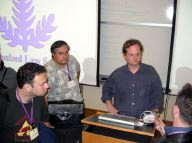 Click to view additional Bloggercon photos.
Larry Lessig opened Bloggercon with a useful statement:
In normal times, people come to univerisities to learn things, these are extraordinary times: Universities (such as) Chicago, Harvard, Northwestern don’t have a clue – we need to go out and find things, bring people here who are doing interesting things. (I’m paraphrasing)
I had the great pleasure of participating in his lively Law section. Lessig provided a very useful overview, including a color coded slide of the current copyright morass and mentioned Creative Commons as an alternative universe for creative folks. He also mentioned that our “fair use” rights from the RIAA/MPAA perspective generally means that we have the right to hire a lawyer (!). The session also included some very informative comments from Hummer Winblad’s Hank Berry, an active participant in the Washington lobbying wars, including the recent induce act madness.
Berry mentioned the following points (check out the video (127MB – about 60% of the session) and listen to the forthcoming mp3’s for more details)
- Utah Senator Orrin Hatch visited Microsoft 3 weeks before he, along with Vermont Democrat Pat Leahy introduced the induce act (I find this rather ironic as Hatch was a proponent of breaking up Microsoft).
- Yahoo evidently refused to discuss the bill, which killed it. Hank said that this was the first time a Silicon Valley firm refused to deal with the RIAA/MPAA folks (kudos to yahoo)
- We also discussed the WinTel “trusted computing” – an oxymoron – scheme. A number of folks expressed concerns that Microsoft and Apple could pull the plug on MP3 support via a software update and thereby kill fair mp3 use…..
Lots of great stuff at Bloggercon. Kudos to Dave Winer for making it happen.
Later: I asked Larry: how do you like the west or east coast approach (He was at Harvard before)? “This is better, people talk…” (vis a vis harvard, nw, chicago, etc.)
9.4MB MP3 | 127MB Quicktime
Real Clear Politics Mea Culpa on their Wisconsin Presidential Vote Prediction
John McIntyre and Tom Bevan’s RealClearPolitics forecast a Bush Wisconsin win. They published a mea culpa, along with the unusual fact that Wisconsin and Iowa split their vote at the federal level.