When the Woodville Mall opened, in 1969, in Northwood, Ohio, a suburb of Toledo, its developers bragged about the mall’s million square feet of enclosed space; its anchor tenants, which included Sears and J. C. Penney; and its air-conditioning—seventy-two degrees, year-round! Two years later, the Toledo Blade published a front-page article about the photo-takers and people-watchers who gathered around the mall’s marble fountain, “that gushing monument to big spending and the shopping spree.” The story quoted an anonymous businessman: “The water has a great calming effect on a person, especially when you’ve been badgered all morning.”
This week, Woodville is being torn down. So are countless other malls across the U.S.—so many that there’s a Web site devoted to “dead malls” that are out of commission. In some cases, the buildings have been converted into community colleges, corporate headquarters, or churches. Others, like the Woodville Mall, have become so damaged by water, mold, and asbestos that city officials are glad to demolish them. In January, Rick Caruso, the C.E.O. of Caruso Affiliated, one of the largest privately held American real-estate companies, stood on a stage at the Javits Center, in New York, and forecast the demise of the traditional mall. “Within ten to fifteen years, the typical U.S. mall, unless it is completely reinvented, will be a historical anachronism—a sixty-year aberration that no longer meets the public’s needs, the retailers’ needs, or the community’s needs,” he told his audience, which had gathered for the National Retail Federation’s annual convention.
Author: Jim Zellmer
The wine business is ripe for disruption, and this man is doing it
“There are only two important people in the wine business—the winemaker and the wine drinker. Right now, they’re both getting screwed.”
Rowan Gormley doesn’t mince words. The founder of Naked Wines, part venture capital firm and part wholesale buying club, has little time for the wine industry’s traditional ways. This might be because he’s an accountant by training. But his background belies a deep appreciation for wine, and a missionary’s zeal for rewriting the rules of how the product gets from grape to glass. He thinks he can apply his financial background and some fresh thinking to shake up the established order in an old-fashioned, exclusive, and often incestuous industry. So far, it seems to be working.
Is This The Future of Digital Citizenship? Estonia’s Networked Society
The E-Estonia system will seem a little Orwellian to some people. Watching the documentary about the system above made me think of the potential dark side of a digital citizenship system in the wrong hands.
However, the system clearly improves lives of Estonian citizens. In a sense, it actually increases their freedom by streamlining their interactions with their government, which makes large and grossly inefficient government bureaucracies less necessary. This could be the reason why Estonians enjoy excellent social services and also pay low taxes by European standards.
The most notable way it improves the lives of Estonians is by reducing the amount of paperwork and time wasted waiting in long lines at government offices. Estonians can renew their passports, update their drivers license, register a new business and access their voting or medical records instantly through the digital citizenship system.
The system is also robust and secure, in fact, it seems a lot more secure than more traditional paper files where it is difficult to track who views them. With their E-Estonia initiative, a digital footprint is created by all activity, which makes everything more secure. As a testament to what the Estonians have created, NATO chose to base their Cooperative Cyber Defence initiative in the Estonian capital of Tallinn.
Regardless of whether you find E-Estonia’s digital citizenship system Orwellian or innovation genius, technology is going to transform the nature of government, citizenship and society itself. With the right digital infrastructure, we can replace inefficient bureaucracies with digital access passes and replace most politicians with crowdsourcing systems where citizens directly participate in the debate and then vote on the issues that affect their lives.
Proofs of Concept
The first iterations of a new technology can seem astonishingly clunky, at least in retrospect. Often, they are more a proof of concept than a practical device.
The first hydrogen bomb, detonated in 1952, was the size of a three-story house and weighed 82 tons. No airplane in the world could have carried it. Within little more than a decade, however, the thermonuclear warheads atop missiles were roughly the size of garbage cans and weighed less than 700 pounds.
A century and a half earlier, the first steam engines were very large and heavy relative to the power they produced. The big engines that drove the Philadelphia waterworks in the early 19th century — the largest steam engines in the country at the time — were built using James Watt’s low-pressure design. They had 32-inch cylinders with a stroke of six feet. But they only put out 12 horsepower. Even the more-efficient high-pressure engines, independently designed by Oliver Evans in the U.S. and Richard Trevithick in Britain, were bulky, and they were ravenous consumers of coal.
We Are All Intelligence Officers Now
I am particularly fond of the late Peter Bernstein’s definition of
risk: “More things can happen than will.”[PB] I like that definition
not because it tells me what to do, but rather because it tells me
what comes with any new expansion of possibilities. Put differently,
it tells me that with the new, the realm of the possible expands
and, as we know, when the realm of the possible expands, prediction
is somewhere between difficult and undoable. The dynamic is that
we now regularly, quickly expand our dependence on new things, and
that added dependence matters because the way in which we each and
severally add risk to our portfolio is by way of dependence on
things for which their very newness makes risk estimation, and thus
risk management, neither predictable nor perhaps even estimable.
The Gordian Knot of such tradeoffs — our tradeoffs — is this: As
society becomes more technologic, even the mundane comes to depend
on distant digital perfection. Our food pipeline contains less
than a week’s supply, just to take one example, and that pipeline
depends on digital services for everything from GPS driven tractors
to robot vegetable sorting machinery to coast-to-coast logistics
to RFID-tagged livestock. Is all the technologic dependency, and
the data that fuels it, making us more resilient or more fragile?
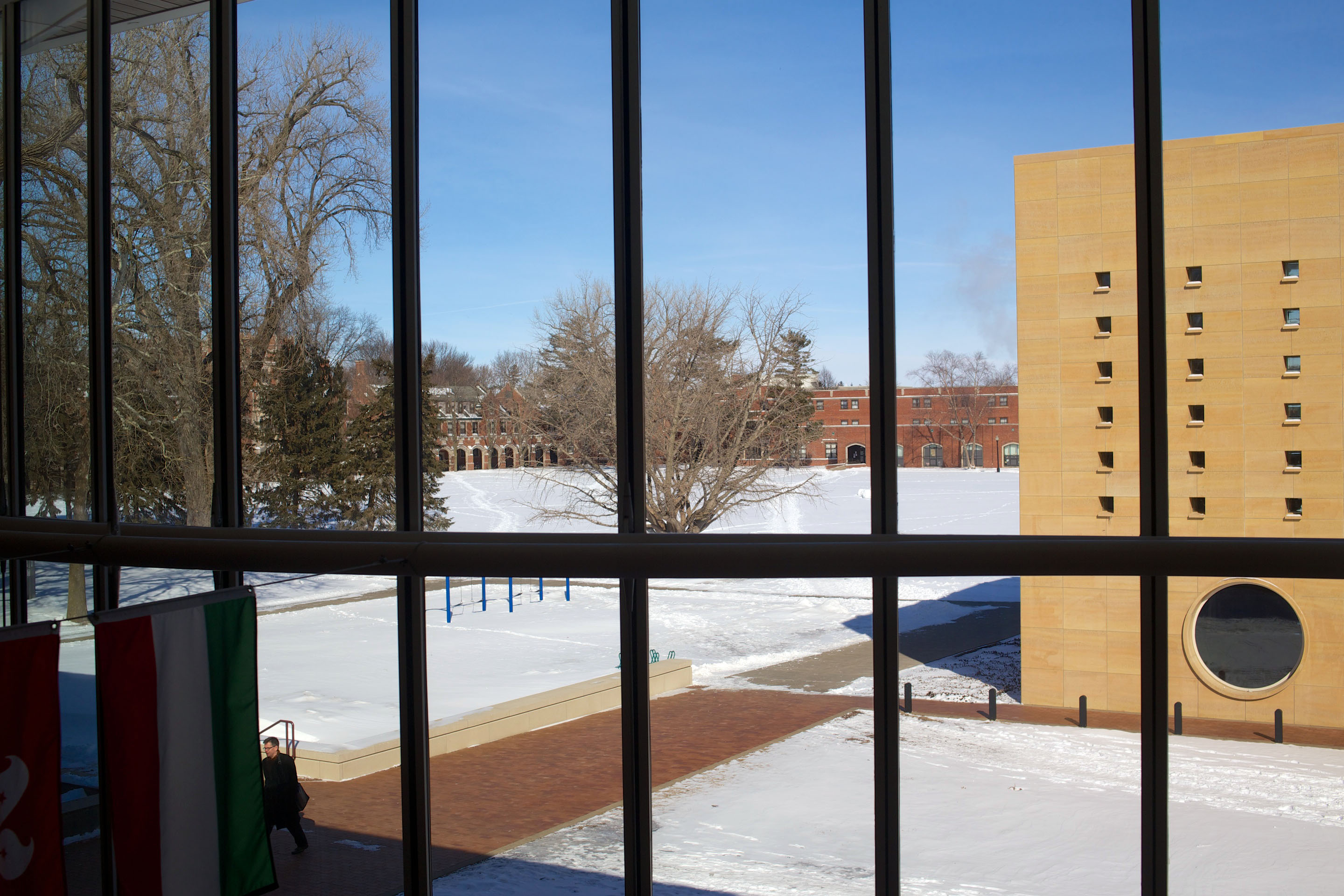
A Brisk, Sunny Day At Grinnell College












Global vehicle sales will likely peak in next decade
The world that Henry Ford put on wheels is poised for a stall.
In the globe’s growing megacities, pollution and gridlock are putting a damper on driving. In India, some commuters are leaving their cars at home to avoid traffic snarls and long prowls for parking.
More young Americans are forgoing the dream of auto ownership for public transport, bikes and vehicle-sharing. Cars on the road are lasting longer than ever.
All of that may herald a new era for an auto industry weaned on a century of global growth. The world will reach “peak car” — a point at which annual global sales growth will top out — in the next decade, several auto-industry analysts predict. Researcher IHS Automotive, for one, sees annual sales cresting at 100 million within that time.
Peak car is at odds with the ambitious expansion plans of global automakers, which IHS says are gearing up to produce more than 120 million vehicles by 2016 — almost 50 percent more than last year’s worldwide sales mark of 82 million. The dynamic also threatens the business plans of parts producers, suppliers of raw material and oil companies.
Driving this upheaval is a rapidly emerging reality: The vehicle that ushered in an unparalleled era of personal mobility in the last century is, in many cases, no longer the most convenient conveyance, particularly as more of the world’s population migrates to big cities.
No one is predicting that car sales will suddenly fall off or that today’s car companies are now dinosaurs. What the experts do see is a reckoning for car companies, which may have to adapt to a world with less car-buying and more car-sharing, more cars that drive themselves and fewer hot rodders on the highway.
“The key question is: Do you sell cars or do you sell mobility?” said Tim Ryan, vice chairman of markets and strategy for consultant PricewaterhouseCoopers LLP. “If you ignore these megatrends, you run the risk of becoming irrelevant.”
View the IHS Automotive Study here.
How Digital Medicine Will Soon Save Your Life You wake up with chest pain. Your smartphone reads your ECG. If it’s a heart attack, it calls an ambulance and sends your data ahead to the ER.
A sweeping transformation of medicine has begun that will rival in importance the introduction of anesthesia or the discovery of the germ basis of infectious disease. It will change how patients and physicians interact. It will change medical research and therapy. “Sick care”—the current model of waiting for you to get sick and then trying to alleviate symptoms and make you well—will become true “health care,” where prevention is the mantra and driving force. Welcome to the world of digital medicine.
First and foremost, the digitalization of medicine will personalize health care: Treatment will be tailored to each person as a unique individual suffering a unique illness according to his or her genetic makeup. Currently, therapy is based on population statistics. Patients are separated into groups defined in various ways but usually by similar symptoms or by the results of basic lab tests (like cholesterol levels). These groups are then treated with drugs that may help many people, but not all of them, and often only a fraction of them. By incorporating information from an individual’s DNA, the data made available through digitalization will enable clinicians to match individuals with treatments. Only patients who will benefit will get a particular drug.
Impossible Cities
In 1298, the Venetian merchant and explorer Marco Polo found himself in a Genoese prison, having been seized at the helm of a war galley during the Battle of Curzola. There he met the chivalric writer Rustichello of Pisa to whom he related tales of his travels along the Silk Road into Asia in the previous decades. The resulting manuscript The Description of the World or The Travels of Marco Polo became a literary sensation, being reproduced across Medieval Europe. Such were the extravagant claims in this “great book of puzzles”, many were taken to be fabrications and Polo earned the nickname “the Man of a Million Lies”. It was doubted by some that he’d even travelled at all except around his own evidently vast imagination.
The accounts did however contain many genuine discoveries alongside exaggerations, half-truths and myths (‘How the Prayer of the One-Eyed Cobbler Caused the Mountain to Move’ for example) mixed together without differentiation. We can now pour scorn on his claims of desert sirens luring the unwary to their deaths, colossal birds who fed on elephants, idolaters “adept in sorceries and diabolical arts” who could control sandstorms or witnessing Noah’s Ark perched on a mountaintop where the snow never melts. At the time, these were scarcely more unbelievable than his claims of “stones that burn like logs” (coal), paper currency, seeing the highest mountains in the world (the Himalayas) or visiting vast golden cities hung with the finest silks yet we know these now to be fairly accurate descriptions.
The backbone of Polo’s travelogue is made up of his visits to various Oriental cities (Baudas, Samarcan, Caracoron and so on) culminating in the opulent palaces of the Chinese Mongol Emperor Kublai Khan, at whose court he was a guest for 17 years. His recollections of the centres and their populaces range from the mercantile (lists of industries and natural resources) to the fanciful; cities where the inhabitants are perpetually drunk, where men ride around on stags eating birds, where marriages are arranged between ghosts or the great Kaan in his marble palace drinks wine from levitating goblets. Often Polo would add boasts and hyperbole (“no one could imagine finer” is a recurring phrase) and even suggest he was holding back for fear of arousing incredulity in the readers (“I will relate none of this in this book of ours; people would be amazed if they heard it, but it would serve no good purpose”) which only served to further his ridicule. When he was on his deathbed, a priest giving last rites asked Polo if he wished to confess to exaggerating his recollections to which he replied, “I did not reveal half of what I saw because no one would have believed me.” Beyond their narrow confines, the world was more extraordinary than his sceptics were capable of imagining. Raised in the seemingly impossible ‘floating city’ of Venice, a maze of canals and alleys built on stilts in a lagoon, Marco Polo had no such limitations.
Anatomy of the Deep State
Rome lived upon its principal till ruin stared it in the face. Industry is the only true source of wealth, and there was no industry in Rome. By day the Ostia road was crowded with carts and muleteers, carrying to the great city the silks and spices of the East, the marble of Asia Minor, the timber of the Atlas, the grain of Africa and Egypt; and the carts brought out nothing but loads of dung. That was their return cargo.
– The Martyrdom of Man by Winwood Reade (1871)
There is the visible government situated around the Mall in Washington, and then there is another, more shadowy, more indefinable government that is not explained in Civics 101 or observable to tourists at the White House or the Capitol. The former is traditional Washington partisan politics: the tip of the iceberg that a public watching C-SPAN sees daily and which is theoretically controllable via elections. The subsurface part of the iceberg I shall call the Deep State, which operates according to its own compass heading regardless of who is formally in power. [1]
During the last five years, the news media has been flooded with pundits decrying the broken politics of Washington. The conventional wisdom has it that partisan gridlock and dysfunction have become the new normal. That is certainly the case, and I have been among the harshest critics of this development. But it is also imperative to acknowledge the limits of this critique as it applies to the American governmental system. On one level, the critique is self-evident: In the domain that the public can see, Congress is hopelessly deadlocked in the worst manner since the 1850s, the violently rancorous decade preceding the Civil War.