Changing Planes at O’Hare: God Smiles on Me!

I’ve now experienced this sort of a very pleasant, unexpected airline experience twice…. in 15 years. Changing planes recently at O’hare, I literally jogged from one end of Terminal B to the far end of terminal F in 9 minutes, trying to catch an early flight to Madison. I arrived at the gate with 6 minutes to spare.

The gate attendant waved me through and I walked outside, toward the 50 seat jet. A member of the ground crew then told me that because the Canadair jet’s doors had just closed, I had to return to the terminal. During this discussion, the Air Wisconsin (United Express) Pilot sent another ground crew member toward me to walk me to the plane. They opened the aircraft and I walked on board…..

Flying through O’Hare several times the past few months, I noticed that flights are far more reliable and predictable than one year ago. I emailed Kevin LaWare, Air Wisconsin’s Vice President of Operations to thank him for this vast improvement in service.

LaWare is in a tough spot, working with a bankrupt major carrier (United Airlines). United is evidently shopping their regional services again (squeezing prices) – putting some more pressure on Appleton based regional carrier Air Wisconsin.

I’m impressed with their service and hope they continue to improve.

UPDATE: The Boyd Group takes apart a recent Wharton Study on the airline industry’s problems.

(more…)

Drexel Burnham Lambert Alumni Article: Brewer’s Mark Attanasio

New Brewer CEO Mark Attanasio gets a few mentions in Jenny Anderson’s article on the Drexel Diaspora:

Several other former Drexel employees are managing billions for pension funds, endowments, wealthy people and one another – often using junk bonds. Mark L. Attanasio, a senior vice president at Drexel when it collapsed, is a managing partner at Trust Company of the West, a $109.7 billion money management firm. Last month, he bought the Milwaukee Brewers for more than $220 million.
Interviews with more than two dozen former employees showed that, far from being embarrassed by their connection to Drexel, most retain an almost cultlike devotion to the firm and much of what it stood for. Few of them were crucial players in building Drexel’s core franchise, junk bonds. And few of them were especially close to Mr. Milken, who has since survived cancer, established two major foundations devoted to cancer research and become a major investor in an education initiative, Knowledge Universe Inc.

Attanasio also worked at Global Crossing with another ex-Drexel player – Gary Winnick.

Photos Verboten: Chicago Publicly Financed Sculpture!

Cory Doctorow:

Chicago spent $270 million on its Millennium Park, placing a big public sculpture by Anish Kapoor in the middle of it, bought with public money. Woe betide any member of the public who tries to photograph this sculpture, though: it’s a copyrighted sculpture and Chicago is spending even more money policing Chicagoans who try to photograph it and make a record of what their tax-dollars bought.

Controlling Madison Property Taxes?

Rob Zaleski wonders why we cannot control property taxes:

Though they don’t get much media attention, there are, in fact, some ideas out there worth pursuing, Reschovsky says.
Among the most promising, he says, is a recent proposal by his colleague Don Nichols, director of the La Follette School of Public Affairs, that would freeze the rate of property taxes on all farms and homes to the rate of income growth of the average Wisconsin resident. The result, Reschovsky says, is that low-income people wouldn’t be driven from their homes. (For more details, see info@lafollette.wisc.edu)
Beyond that, some states have tried assessment caps, with mixed results, Reschovsky says. The best example, of course, is California’s controversial Proposition 13, which was passed in 1978 and limits increases in assessed value to 2 percent a year. A house gets reassessed at full value only when it’s sold.

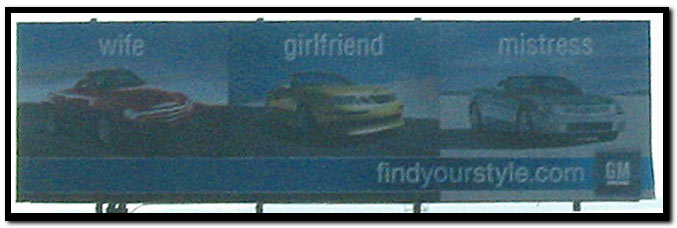
GM Auto Marketing: Find Your Style (Wife, Girlfriend, Mistress)


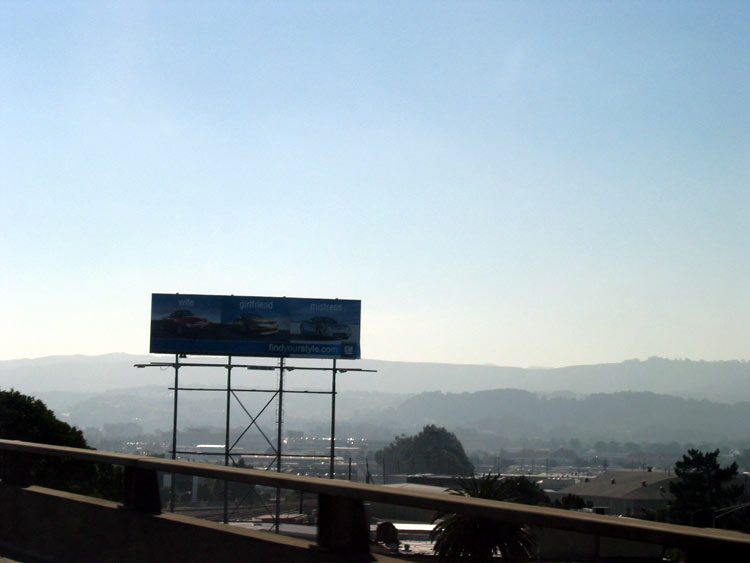
Driving back to SFO recently, I noticed this GM (General Motors) billboard. In essence, the message to Northern California drivers bound either for SFO or their jobs on the Peninsula or in Silicon Valley was:

Advertising is often a useful way to peer into the soul of a company, or in other words, think about their dna and how the firm views its interaction with the outside world.

This campaign smells desperate to me. I’m reminded of Sun Microsystems co-founder Bill Joy’s spot on statement regarding software: “The quality of a company’s software has an inverse relationship to the amount spent on marketing.”

I must admit that this ad campaign doesn’t click at all for me, from any angle. The whole pitch, including the website, seems like a lot of fluff. I visited the site and it promptly crashed my computer (PC, in this case). I tried again and it worked, although it later crashed just my browser.

Perhaps this all makes sense for some car buyers…..

I think GM would be much better off seeding cars to bloggers and schools for long term reviews (with the agreement that they write about their year or two with a sedan, minivan, SUV or sports car). This will take some doing, but I think it would be money well spent. Essentially, they need to route around the legacy media (see Bob Lutz’s notes on this).