WSJ: 2006 Tech Innovation Winners

Wall Street Journal:

Computer systems are notoriously finicky. They’ll hum along just fine and then unaccountably slow down, freeze up or stop working altogether. Finding the cause of some unexplained problem is difficult and time-consuming, especially with complicated systems in real-life settings.

Bryan Cantrill and a team of engineers at Sun Microsystems Inc. have devised a way to diagnose misbehaving software quickly and while it’s still doing its work. While traditional trouble-shooting programs can take several days of testing to locate a problem, the new technology, called DTrace, is able to track down problems quickly and relatively easily, even if the cause is buried deep in a complex computer system.

The DTrace trouble-shooting software from Sun was chosen as the Gold winner in The Wall Street Journal’s 2006 Technology Innovation Awards contest, the second time in three years that a Sun entry has won the top award. The panel of judges, representing industry as well as research and academic institutions, selected Gold, Silver and Bronze award winners and cited one technology for an Honorable Mention.

For the awards, now in their sixth year, judges considered novel technologies from around the world in several categories: medicine and medical devices, wireless, security, consumer electronics, semiconductors and others.

PDF summary of all the winners.

“Ban Carry-on Luggage”

NYT Editorial:

In a directive whose logic is not always apparent, the Transportation Security Administration has spelled out what airline passengers can carry on board with them, what must be placed in checked luggage, and what can’t go on the plane at all. Knives must be checked but knitting needles and corkscrews are allowed in the cabin. Up to four ounces of eye drops can be carried aboard, with fingers crossed that multiple terrorists won’t combine their allotments to exceed the limit. Laptops, digital cameras, mobile phones and other electronic devices are permitted, so never mind any warnings you’ve heard that they could be used to trigger a bomb. The bomb ingredients themselves, notably liquid explosives, will be kept out of the cabin by a ban on liquids, gels and lotions, except for small amounts of baby formula and medications.

Ethanol, Ethanol Everywhere, Time to Stop and Think

Elon Musk:

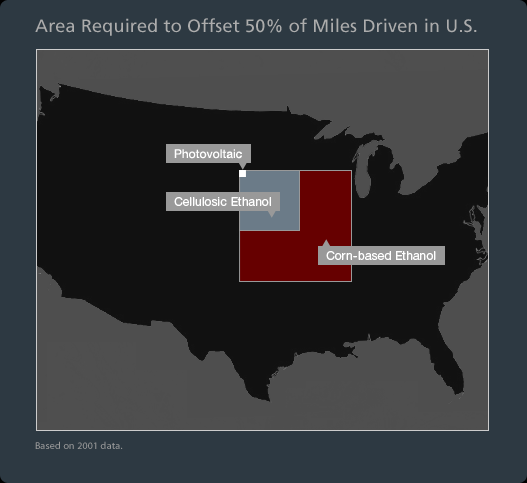
Ethanol (a.k.a. alcohol) will certainly grow as a business and serve as a partial solution to our energy problem, particularly given that it is now taking the place of the gasoline additive MTBE. However, even if large-scale cellulosic ethanol technology is perfected, I don’t believe it can become the primary solution to the world’s energy needs.

The often-used example of Brazil does not apply to most parts of the world and may not even apply to Brazil if they see high economic growth with its attendant energy demands. Brazil is in the tropics with an all year round growing season and an enormous amount of arable land relative to its population food requirements and the number of cars on the road.

In contrast, domestic ethanol as the primary solution will definitely not work for the world’s most populous countries, such as Japan, China, India, Pakistan, Indonesia, etc. Those countries are either breaking even on domestic food production or are net importers. If you argue that ethanol is to be grown elsewhere and shipped, where are the vast tracts of unused arable land? And, bear in mind, the calories burned by two ton cars are much greater than those burned by 170 pound humans.