The App Store.
Author: Jim Zellmer
Startup Idea: Used Car Leasing
Applications that open up spare capacity are a big deal. First eBay did it with the spare capacity of stuff in your attic. When counting pro sellers, eBay is the largest employer in the world. Next Airbnb took the spare capacity of your spare bedroom and turned it into the largest hotel in the world.
Cars could be next. There are ride sharing services, but they are modeled after Zipcars. That pattern works well for cities where driving is rare. For me, driving is extremely regular: get the kids to school, go to work, get groceries, etc. Getting a Zipcar daily doesn’t make sense, so the car sharing equivalents don’t either.
The model that does make sense is leasing, but leasing today stinks. First you have dealerships. Whether buying a new car, buying a used car, selling a used car, or leasing a new car, negotiating stinks, and it takes an actuary to figure out an optimal outcome. Selling a car on Craigslist is really cumbersome too, and Craigslist does nothing to smooth the transaction.
What If We Never Run Out of Oil?
As the great research ship Chikyu left Shimizu in January to mine the explosive ice beneath the Philippine Sea, chances are good that not one of the scientists aboard realized they might be closing the door on Winston Churchill’s world. Their lack of knowledge is unsurprising; beyond the ranks of petroleum-industry historians, Churchill’s outsize role in the history of energy is insufficiently appreciated.
Winston Leonard Spencer Churchill was appointed First Lord of the Admiralty in 1911. With characteristic vigor and verve, he set about modernizing the Royal Navy, jewel of the empire. The revamped fleet, he proclaimed, should be fueled with oil, rather than coal—a decision that continues to reverberate in the present. Burning a pound of fuel oil produces about twice as much energy as burning a pound of coal. Because of this greater energy density, oil could push ships faster and farther than coal could.
Churchill’s proposal led to emphatic dispute. The United Kingdom had lots of coal but next to no oil. At the time, the United States produced almost two-thirds of the world’s petroleum; Russia produced another fifth. Both were allies of Great Britain. Nonetheless, Whitehall was uneasy about the prospect of the Navy’s falling under the thumb of foreign entities, even if friendly. The solution, Churchill told Parliament in 1913, was for Britons to become “the owners, or at any rate, the controllers at the source of at least a proportion of the supply of natural oil which we require.” Spurred by the Admiralty, the U.K. soon bought 51 percent of what is now British Petroleum, which had rights to oil “at the source”: Iran (then known as Persia). The concessions’ terms were so unpopular in Iran that they helped spark a revolution. London worked to suppress it. Then, to prevent further disruptions, Britain enmeshed itself ever more deeply in the Middle East, working to install new shahs in Iran and carve Iraq out of the collapsing Ottoman Empire.
Google cars versus public transit: the US’s problem with public goods
I have an excellent job at a great university. I have a home that I love in a community I’ve lived in for two decades where I have deep ties of family and friendship. Unfortunately, that university and that hometown are about 250 kilometers from one another. And so, I’ve become an extreme commuter, traveling three or four hours each way once or twice a week so I can spend time with my students 3-4 days a week and with my wife and young son the rest of the time.
America is a commuter culture. Averaged out over a week, my commute is near the median American experience. Spend forty minutes driving each way to your job and you’ve got a longer commute than I in the weeks I make one trip to Cambridge. But, of course, I don’t get to go home every night. I stay two to three nights a week at a bed and breakfast in Cambridge, where my “ludicrously frequent guest” status gets me a break on a room. I spend less this way than I did my first year at MIT, when I rented an apartment that I never used on weekends or during school vacations.
This is not how I would choose to live if I could bend space and time, and I spend a decent amount of time trying to optimise my travel through audiobooks, podcasts, and phone calls made while driving. I also gripe about the commute probably far too often to my friends, who are considerate if not entirely sympathetic. (It’s hard to be sympathetic to a guy who has the job he wants, lives in a beautiful place, and simply has a long drive a few times a week.)
Boris Sofman’s answer to Anki: How are Anki cars different from other toy cars? What are the robotic features?
Thank you for your question — this is a very important one.
The cars in Anki Drive are characters in a video game brought to life in the physical world.
Anki Drive cars are extremely different from other types of cars (plastic, RC, etc.). They are very complex and capable robotic systems that can bring the characters they represent to life in a way that has never been possible outside of a video game: with intelligence, personality, and true interaction. For the first time, you can play a game where whatever cars you don’t control come to life and are controlled by the AI, reacting autonomously to what you’re doing and what the other cars are doing. The have a lot of sensors, motors, and computation internally (50 MHz microcontroller in each car) to make this possible.
In terms of their capabilities, there are 3 key challenges of robotics that we had to solve to make Anki Drive, and the capabilities of the cars within, possible:
Positioning — every car needs to understand precisely where it is, and where the other cars are relative to it. To do this, each car scans its environment 500 times per second to know with exact precision where it is located on the track, and wirelessly communicates that back to the mobile devices running the game.
Reasoning — Once the cars know where they are, we use that information to make intelligent decisions and plans for the cars that are controlled by the game. We use mobile devices as the ‘brains’ behind the real-world game, thinking about thousands of potential actions every second for each car.
Prius + 10: Performance Is All That Matters
TOYOTA, RESTORED AS the world’s largest auto maker by sales in 2013, produces lots of amazing vehicles. It makes the world’s most durable small pickup, the Hilux. On the other side of the vehicular universe, there is the Lexus LFA, a carbon-bodied apparition with a naturally aspirated V10 engine and a spine-tingling 9,000 rpm redline. Me want.
Toyota 7203.TO -0.47% builds the best-selling sedan in America, the Camry; it builds full-size, steak-eating trucks in Texas (more than 1 million at last count). This company has bandwidth.
The Loss Of The Unmonitored Self
Historians will look back at the past 20 years as a unique period, a time when there was great opportunity to see deep into the collective soul of entire societies because people’s online behavior was largely naked of any fears of being judged or monitored.
Novelist Gabriel García Márquez wrote: “All human beings have three lives: public, private, and secret.” We once had insight into that secret world.
People now go “dark” — ditching their natures, becoming self-monitored, self-critical, and second guessing themselves and everything around them, in the wake of the NSA disclosures and the enormous amount of corporate spying on individuals, so that they will buy more products. We lose far more than we gain.
The individual and their search box was almost as private and sacrosanct as the communion box — and exhibited the same honesty. You can see this in the search data that AOL released in 2006 as part of a research project. It anonymized 658,000 users but for the first time we got to see a narrative from each user that pointed to great sorrow and drama within ordinary peoples’ lives that could not be revealed in any other way.
Here is a list of searches by user “005315”:
Design Thinking at Kohler Presentation
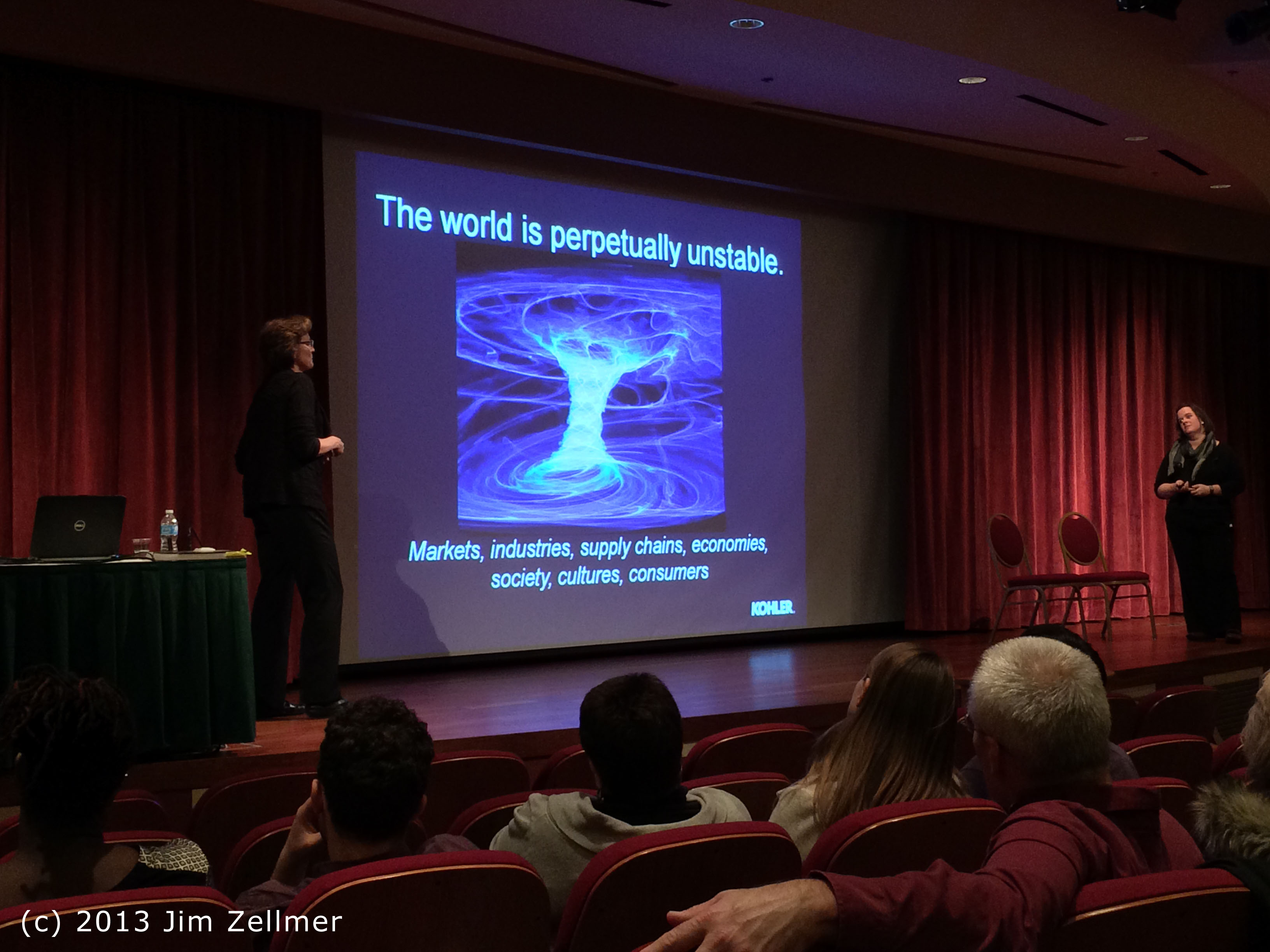
Mary Reid, Kohler’s VP Industrial Design gave a worthwhile presentation on “Design Thinking” this evening at Monona Terrace.
This image was taken with my iPhone 5s in relatively low light. Rather impressive.
Mary’s presentation included a brief discussion on technology & plumbing, including wifi and bluetooth equipped toilets along with a shower head that includes a bluetooth speaker.
Somewhat related: Consumer DSLRs “dead in 5 years” and my comments on the rapidly expanding world of iPhone photography.
Asymcar 6: Peak Horse
Steve Crandall brings a new perspective as a guest. Steve’s analysis of complex systems has given him a huge pool of wisdom into which we dip our dainty spoons.
We survey the interlopers seeking to replace many jobs that cars have traditionally done, from horses to bicycles, planes, trains and buses.
We dive deeper into a few earlier Asymcar topics including energy, regulation, infrastructure, power train evolution, societal changes, distribution networks, urbanization and consider the promise of electric bicycles.
Several innovation timing lessons temper our expectations for immediate improvements.
Finally, we revisit the emerging transportation information layer and how such services may change public behavior and the auto-ecosystem.
Ansel Adams: Master Photographer, Master Marketer
It has now been five years since the global economic system nearly collapsed into ruin, and the ensuing half-decade has been difficult for most — apart from the infamous 1 percent — including professional photographers. The ease and accessibility of digital technology combined with the rise of the mostly free Internet have eliminated many of the ways photographers eked out a middle-class living. Even university jobs — once a stable and comfortable perch — have been replaced by cheap and benefits-free adjuncts.
What’s a struggling photographer to do?
The burgeoning model requires a Malcolm X “By Any Means Necessary” attitude. Photographers are encouraged to write, blog, teach workshops, engage in social media, secure sponsorships, develop exterior passions and basically do anything and everything to put food on the table. One blogger has called the phenomenon the “21st century hustle.” (O.K., that blogger is me.) But as much as this feels new and different, we can trace the Renaissance-man lineage back to the most famous American photographer in history: Ansel Adams.
Mr. Adams, ever the optimist, once proclaimed: “The best picture is around the corner. Like prosperity.” That sums up his future-embracing outlook, because when Mr. Adams committed himself to his career, there were few examples of successful professional photographic artists whom he could emulate. Ansel Adams’s career provides a road map to potential success while also serving as a reminder that everything old will be new again.