The Transportationist, David Levinson (@trnsprttnst) joins us to discuss the technical, human, environmental and economic factors driving change to the auto-ecosystem.
Author: Jim Zellmer
God’s Handiwork: Orchids


Tap or click for a larger version.
Broadcast Audience Older Than Ever Ratings hold up while viewers continue to age out of the demo
Call it déjà view.
With three weeks of Nielsen data in the books, the 2013-14 broadcast TV season is shaping up to be a carbon copy of last year’s campaign. Ratings are effectively flat versus the first three weeks of last season, and the trends that have stymied networks for years (a rapidly aging audience, commercial avoidance) show no sign of reversing field.
For the period spanning Sept. 23-Oct. 13, overall deliveries are up a smidgen (8.17 million viewers versus 8.13 million in the year-ago period), while the average rating for adults 18-49 is flat at a 2.3. As was the case a year ago, NBC is in first place among live-same-day deliveries, averaging a 2.9 in the demo, while CBS and ABC are tied with a 2.1. Bringing up the rear is Fox (1.9).
As stable as the early ratings have been, the age discrepancy between now and 12 months ago is a bit disconcerting. But for ABC, every network has aged up a bit versus the year-ago period, bringing the average broadcast viewer to a ripe old 53.9 years. In other words, nearly half of those watching network television have aged out of the 25-54 demo.
With a median age of 58.2 years, CBS remains the oldest-skewing of the Big Four. No fewer than 10 CBS programs—NCIS, Blue Bloods, Hawaii Five-0, NCIS: Los Angeles, The Good Wife, Undercover Boss, The Mentalist, Person of Interest, 60 Minutes and 48 Hours—deliver a median age of 60 years and up, and the Friday night cop show Blue Bloods is the grayest of all (62.6).
Driverless Cars Are Further Away Than You Think
A silver BMW 5 Series is weaving through traffic at roughly 120 kilometers per hour (75 mph) on a freeway that cuts northeast through Bavaria between Munich and Ingolstadt. I’m in the driver’s seat, watching cars and trucks pass by, but I haven’t touched the steering wheel, the brake, or the gas pedal for at least 10 minutes. The BMW approaches a truck that is moving slowly. To maintain our speed, the car activates its turn signal and begins steering to the left, toward the passing lane. Just as it does, another car swerves into the passing lane from several cars behind. The BMW quickly switches off its signal and pulls back to the center of the lane, waiting for the speeding car to pass before trying again.
Putting your life in the hands of a robot chauffeur offers an unnerving glimpse into how driving is about to be upended. The automobile, which has followed a path of steady but slow technological evolution for the past 130 years, is on course to change dramatically in the next few years, in ways that could have radical economic, environmental, and social impacts.
The first autonomous systems, which are able to control steering, braking, and accelerating, are already starting to appear in cars; these systems require drivers to keep an eye on the road and hands on the wheel. But the next generation, such as BMW’s self-driving prototype, could be available in less than a decade and free drivers to work, text, or just relax. Ford, GM, Toyota, Nissan, Volvo, and Audi have all shown off cars that can drive themselves, and they have all declared that within a decade they plan to sell some form of advanced automation—cars able to take over driving on highways or to park themselves in a garage. Google, meanwhile, is investing millions in autonomous driving software, and its driverless cars have become a familiar sight on the highways around Silicon Valley over the last several years.
The allure of automation for car companies is huge. In a fiercely competitive market, in which the makers of luxury cars race to indulge customers with the latest technology, it would be commercial suicide not to invest heavily in an automated future. “It’s the most impressive experience we can offer,” Werner Huber, the man in charge of BMW’s autonomous driving project, told me at the company’s headquarters in Munich. He said the company aims to be “one of the first in the world” to introduce highway autonomy.
Why US New Car Sales To The Youngest Generation Of Drivers Slowed In 2013
After years of lackluster performance, car buyers aged 18 to 34 bought relatively more cars than older buyers in 2012, gaining share even as the overall market grew 13 percent. But the pace of sales by these Millennials slowed again in 2013, reversing nearly all 2012 share gains. A slowdown in new jobs for young adults, while the job market for older workers expanded, contributed to the turn around. Plus, the weaker labor market, combined with higher prices and tight supply in the housing market, meant many fewer Millennials formed new households this year, minimizing another key factor from 2012’s car sales growth. Meanwhile, wealth effects from a strong stock market and rising home values — a key growth driver for the market overall — likely contributed less to motivating new car purchases by Millennials than by older buyers.
From 2007 to 2011, the share of sales to car buyers aged 18 to 34 fell nearly 30 percent. Then, when many industry observers verged on writing off this generation as uninterested in cars and driving, the economic tide turned in 2012 and Millennials flocked to buy new cars, recovering over a quarter of their share losses and doing so in a rapidly expanding auto sales market. This surge was short-lived, however. In the first eight months of 2013, the share of new car sales to Millennials dipped almost to 2011 levels. Although the breakdown of sales by income among Millennials remained fairly stable, Millennial buyers retreated at all income levels, with higher-earning households posting the largest share losses.
Ah; iMovie on iPad Air Impressed me Today
I recently put together a 25 minute video using iMovie on iPad Air. The movie included a number of video clips, audio and still images.
Adding and editing media is trivial. Multi-touch events make quick work of moving and modifying assets, transitions and audio effects.
Moving about 2GB of media assets to the iPad air required the very nice Photosync app.
One less task for the MacBook Air and perhaps another challenge for the traditional camera manufacturers. I plan to give iMovie a try on my iPhone as well.
Why an 80% market share might only represent half of smartphone users
Here’s the image for the seven days to 1 November 2013, showing what version of Android was used by devices connecting to Google Play. Among them is “Froyo” (2.2) and “Honeycomb” (3.0). You can’t actually buy new Android devices running either of those. Yet both make up a notable proportion. The newest software, “Jelly Bean” (which actually covers three different numbering versions), accounts for 52.1% of the devices. Yet Jelly Bean is the software powering all those new Android phones – the ones that were the 80% in the past quarter. Clearly, the installed base doesn’t reflect the market share number.
Fine. But look, I saw some figures which said that last year Apple’s market share in tablets was 50%, and now it’s 30%. So Apple’s selling fewer tablets, right?
No, that’s not what that data tells you. What if the total number of tablets being sold has doubled? If last year there were 100m tablets sold in total, and this year 200m, then last year the figures would be 50m tablets and this year 60m. (Those aren’t the numbers. They’re just for illustration.)
So if you don’t have the absolute numbers, you don’t know what’s happening. Those sort of year-to-year comparisons can be helpful to visualise changes in the market landscape, but in fast-changing markets it’s not enough just to quote a single number. In some ways it obscures more than it reveals.
(Note that Google’s diagram above doesn’t have any numbers beyond the “share”; we don’t know if more devices connected to Google Play, and if they did, how many more that was compared to a month or year ago.)
Here’s an example, from YouGov in 2013, which showed Apple losing market share. Its share of the installed base had fallen, YouGov said, from 73% to 63% (note that unusually, this was an “installed base share”, not a “sales market share”).
And yet putting in the figures for how many units were bought showed that Apple had increased its installed base and increased its lead in that installed base. That’s counterintuitive. Yet it emerges directly from the calculation: the iPad installed base had gone from 2m to 5.3m; it had gone from having 0.6m more tablets than all its rivals combined, to having 3.1m more.
This doesn’t mean there won’t be more non-iPad tablets than iPads at some point. But it does mean that you need to enquire more carefully about absolute numbers when you’re presented with the word “share”. It’s absolute numbers that tend to matter.
Is Tesla Stock Running Out of Juice? “It’s Going to Be a Really Giant Facility”
The growth reported last week by Tesla Motors was impressive for a car company, let alone an American car maker still in its first year of volume production.
Tesla (ticker: TSLA) delivered 5,500 units of its sleek, all-electric Model S in the September quarter, producing revenues of $431 million—more than eight laps ahead of the $50 million achieved a year ago. The Palo Alto, Calif.-based company reported profits of $16 million, or 12 cents a share (if you set aside 40 cents worth of non-cash charges and lease accounting required by generally-accepted accounting principles).
Still, some investors had more extravagant expectations for the electric car maker run by celebrated entrepreneur Elon Musk. Most analysts had predicted deliveries for the quarter ending in September of near 6,000 cars; some, over 7,000. Then a Model S caught fire Wednesday after its battery got punctured by road debris. The driver escaped unharmed, but it was the second such incident in six weeks. From Tuesday to Friday, the car maker’s shares skidded 23% to $137.95.
…..
Musk also expressed confidence that Tesla could improve the cost efficiency of its power cells in the couple of years’ time required for the third-generation car to go into production. Meanwhile, Tesla is talking to potential partners about building a battery factory in North America.
“It is going to be a really giant facility,” Musk said. “We are talking about something that’s comparable to all the lithium-ion production in the world, in one factory. That’s big.”
Connected Cars & Advertising
We saw dashboards that had multiple presets allowing listeners to go from Pandora to NPR to and iTunes account in the same way they use radio presets now. We heard one young woman say, “Poor FM. I don’t listen to it anymore because I don’t have to,” as she described how she used to listen in her old car and how her new car has her spending time with other alternatives. Others on the video explained how they use radio, and it was clear that the hands-free environment changes how they access radio. And the radio people in the audience saw clear evidence for how they need to talk to their audience to make sure their station ends up as one of the alternatives sought out in the connected car.
Rosin pointed out that these connected car drivers will listen to radio only when radio offers unique, compelling, live and local content they can’t get anywhere else. One major advertiser, Fred Sattler, EVP/Managing Director for Initiative + in Los Angeles — he controls advertising for Hyundai and Kia — reinforced that radio won’t hang on to advertisers unless it is offering live, local content. He said syndicated air personalities are not unique enough to the local town, the local dialogue, and the needs of the local community to interest him as an advertiser in a connected car environment. That means some radio companies today are moving away from radio’s best remaining strength: unique local content.
It’s impossible to summarize a two-day event here, but a good starter is checking the Twitter hashtag #DASHAudio. Frankly, those not in the room who sent representatives to report back will get bullet points, but may well miss the essence of what those who were there received. I suspect every radio person who attended is already changing things about their strategy as a result of lessons learned at DASH.
And some of those lessons were hard to swallow. For instance, a panel of local car dealers who were previously giant radio spenders revealed why, in a couple of cases, radio has fallen off their radar and budgets have been shifted elsewhere. Jaws in the room dropped when we learned that part of the migration away from radio could have been prevented. More jaws dropped when dealers discussed radio’s lack of data and proof of performance compared to Pandora.
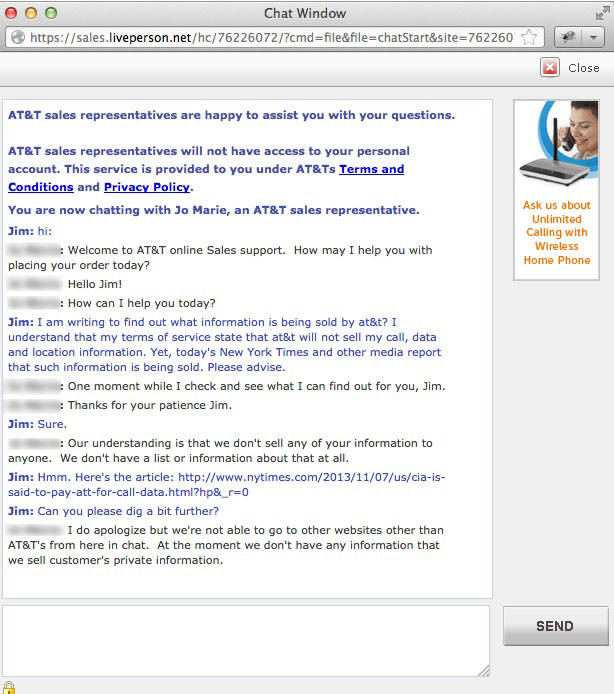
A Brief Chat with AT&T on Selling My Data
In light of Charlie Savage’s article on AT&T monetizing their user data, I asked “ma bell” about their data practices. A transcript follows: