
It is always interesting to watch the world go by. Tap or click to step inside the panoramic image, then press and pan in any direction.
Author: Jim Zellmer
RIP: Cash Registers?
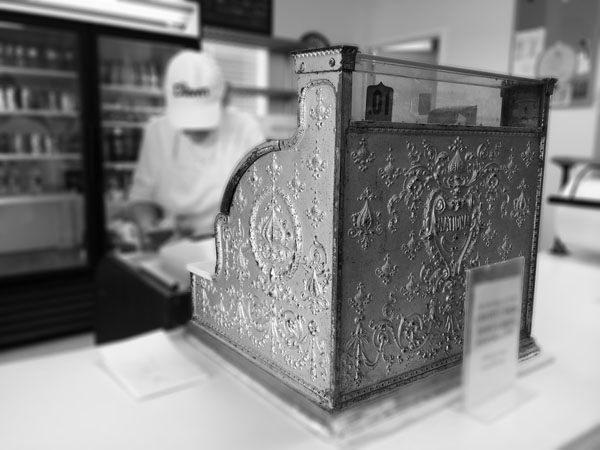
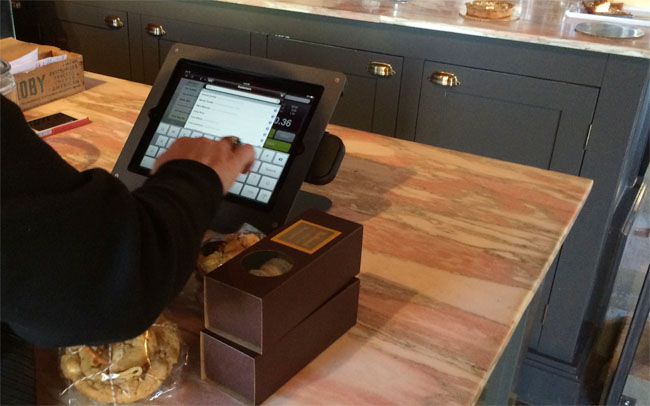
Green Tea. Salad. Oatmeal. Soup. Fruit. Yogurt. Bacon Cheddar Muffin (caught my eye at a sprout style coffee shop, but not for me). These are just a few of the items I’ve purchased when on travel using increasingly popular iPad “cash registers”. Interacting with them more frequently, I’ve begun to catalog installations and reflect on their use.
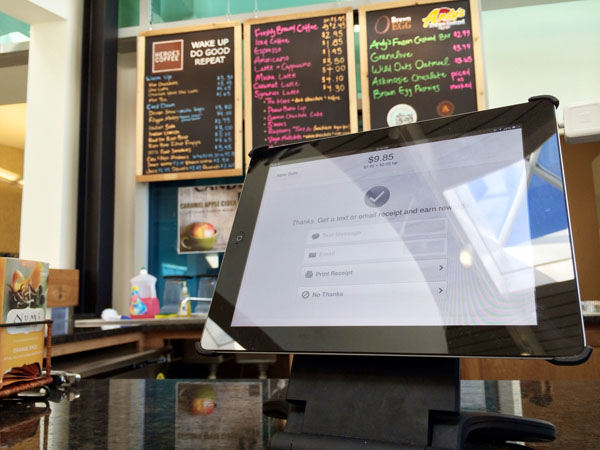
The term “cash register” [wikipedia] understates much of what the iPad and the supporting cloud software is actually doing. I often ask the attendant or proprietor how they like the iPad + software combination. The most popular response – admittedly, unscientific – is the ease with which they can manage their products and prices. One manager mentioned how difficult it was to reconfigure pricing and products on their previous Windows based “cash register”.
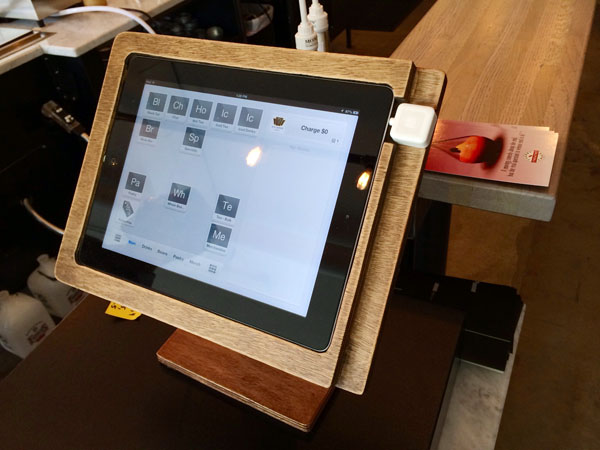
Apps + Cloud
The examples I’ve witnessed use a “cloud” based service: NCR “Silver”, Square and ShopKeep to name a few. The proprietor configures and manages the POS (“Point of Sale”) iPad system from a browser or a management app. Changes are often available immediately. The iPad provides a fast, touch interface to cloud-based data processing. In some ways, this phenomena is a return to the client/server era of the 1990’s.
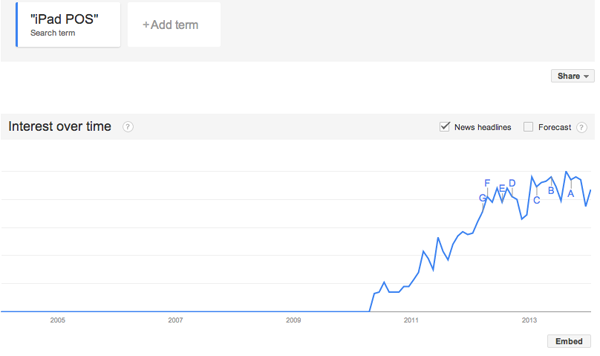
Google Trends “iPad POS”
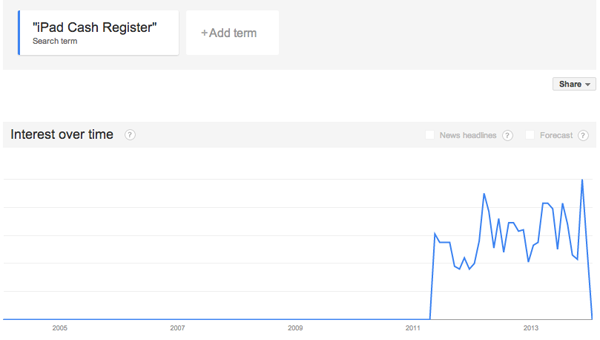
Google Trends “iPad Cash Register”
Productivity
I observed a number of clients selecting their contact record to tag a purchase for the store’s affinity program.
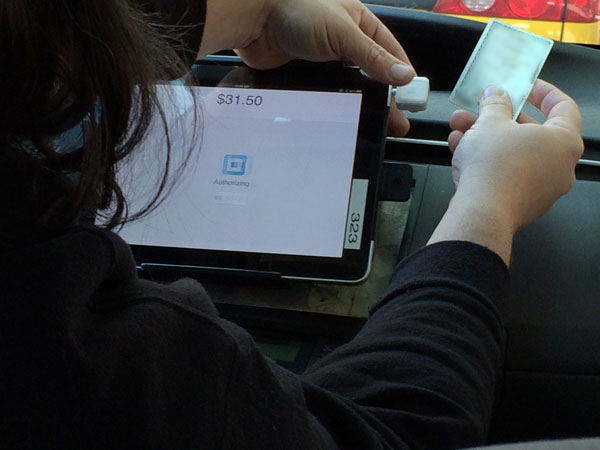
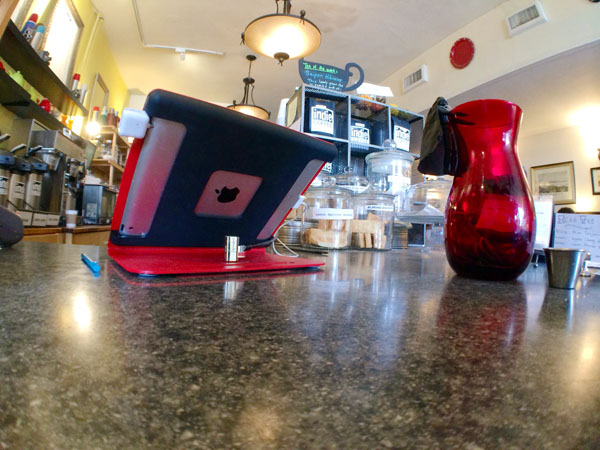
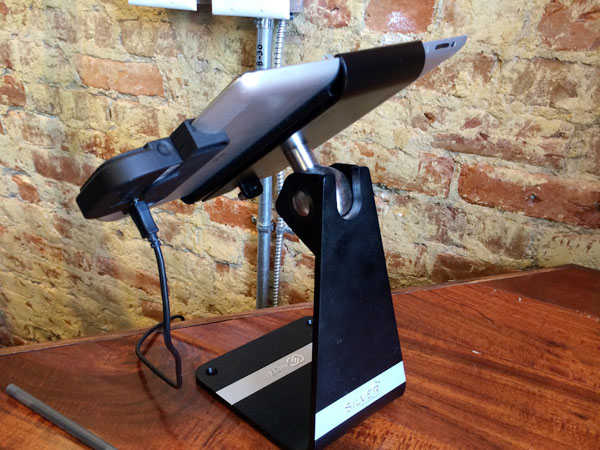
This points out another benefit of iPad Point of Sale Apps: clients can often enter or update their own information, saving staff time. The iPad stands quickly rotate so that the customer can complete their information and request a receipt – via email.
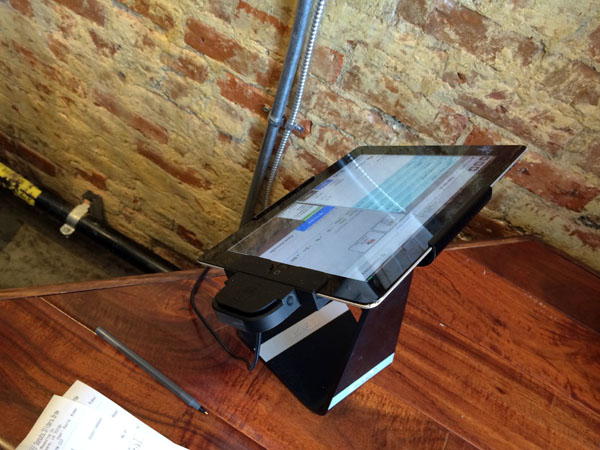
I observed one cafe with “black box” 7″ tablets tied to a POS system. Presumably we will see more payment service bundling, particularly from Google, Amazon and others.
But…..
“The cloud is not perfect, it’s not for everyone” – so said the owner of a multi-generation successful restaurant – still using traditional cash registers. I asked this fellow if he considered an iPad cash register app/service?
“You know, the cloud has flaws from privacy to business risk. I’ve looked and looked (and looked) for an iPad POS app that keeps my data local and have yet to find one. I want to control my data.”

Opportunities:
Software
One can imagine many interesting business and service combinations from banking, crm, delivery and ibeacons. New user experiences will emerge, perhaps including “frictionless” purchases via emerging credential services ala Touch ID.
iPad POS system growth is yet another indicator of the iOS eco-system’s strong developer appeal.
Hardware
The next logical step is to eliminate – or make irrelevant – the physical “cash register”, moving the order and payment process to the client’s device such as a smartphone and/or iPad. Perhaps the POS vendors, or one of the eco-system platforms will create and grow a pervasive location aware payment service that interacts with iBeacon-style devices.
Cloud Financial Data
I concur with the proprietor concerned about cloud financial data.
On a related personal data matter, I recently contacted Automatic to see if I might use their auto data tracking device and app without moving all of my information to their services (and “business partners”). I received this response:
This is technically possible, but not as easily done. As long as you have a data plan on your phone, it will upload data to our servers for processing. The only way to prevent it entirely is to not be connected to the internet at all. You’ll still need to connect initially to create an account for the setup process though.
Without an internet connection, trip recording may not work flawlessly all the time as some of it is dependent on our servers for processing. You won’t be able to install any firmware updates for the Link and other features of Automatic won’t work without a connection. Check out this topic in our Community for more information. http://community.automatic.com/automatic/topics/requiring_mobile_data_gps
-Ani
Customer Success
An optimist, I am hopeful that we will see more user controlled data options, soon.
Destiny
I suspect within 5 years (3?) the iPad cash register app model will be old news, largely replaced by location aware client devices.
Notes: The photos above were taken with my iPhone 5s, with the exception of the first, which was taken with my Sigma DP2m. The wood iPad POS stand was my favorite. It was found in a rather high-rent tea cafe.
Detroit motor show: how the US youth fell out of love with car culture The under-35s are driving less and less, a problem that America’s automobile industry is desperate to find a solution to
As the world’s car industry leaders head to the gargantuan Detroit annual motor show this week, many of them will be in the most upbeat mood for years. Sales are back, the car companies are all making profits. But having weathered the worst recession in living memory a big black cloud still hangs above – young people aren’t buying.
Car and youth culture synched gears decisively in 1955. That was when James Dean played chicken in a black Ford Super De Luxe in Rebel Without a Cause. But more recently the love affair between youth and wheels seems to have broken.
New car purchases by those aged 18-34 dropped by 30% in the US between 2007 and 2012, according to the car shopping website Edmunds.com. Many American under-35s are now not even getting their licence. Given that so called “millennials” – those born between 1983 and 2000 – are now the largest generation in the US, the trend is worrying car firms.
Meanwhile the number of miles driven by Americans each year has also started to drop –they now drive fewer miles per capita than at the end of Bill Clinton’s first term, according to a report released last year by US PIRG Education Fund. And the age group showing the biggest decline? Those aged 16 to 34, who drove 23% fewer miles on average in 2009 than in 2001.
Stuck: Why Americans Stopped Moving to the Richest States
In 1865, Horace Greeley said “go west, young man,” and, for a century and a half, men and women, young and old, were keen to listen. Even into the early 2000s, the sunbelt stretching into the suburban southwest fattened with new housing developments—ultimately, to disastrous effect. But in the last decade, the ambition to go west has been replaced with a lazier notion—to “stay put.”
“Americans are moving far less often than in the past, and when they do migrate it is typically no longer from places with low wages to places with higher wages,” Tim Noah wrote in Washington Monthly. “Rather, it’s the reverse.” Why America lost her wanderlust is not entirely clear—perhaps dual-earner households make long moves less likely; perhaps the Great Recession pinned underwater homeowners on their plots—but those still wandering aren’t going to the right cities.
When Greeley suggested a westward move, he wasn’t making an argument for sun and gold. He was, above all, suggesting that young people escape from areas with expensive housing:
On the trail of Fred Harvey, tamer of the Wild West
Driving from New York to Kansas City with Harvey has not only been fun and a visual feast, it’s also been an education in his family’s illustrious history, in which the El Tovar Hotel featured prominently. Situated a few steps from the edge of the Grand Canyon, it is probably the shiniest and most famous jewel in the crown, or rather string, of hotels, restaurants and shops established by Fred Harvey, Steve’s great-great grandfather.
Frederick Henry Harvey was born in England in 1835 and became a naturalised American soon after landing on Ellis Island at the age of 17. Intelligent, capable and possessing a furious work ethic, he started out as a simple “pot walloper” (dishwasher) in a New York restaurant and grew to preside over a mighty hospitality empire, revolutionising the way Americans travelled, ate and went sightseeing. He became known as the “civiliser” of an, at the time, extremely uncivilised and very wild west. Harvey developed the first restaurant chain, the first “fast food” outlets (although he used only the freshest, choicest ingredients – as opposed to the highly processed cuisine we associate with the phrase today), the first tourism industry in the American southwest, the first all-female workforce and the first company merchandise and postcards. He also organised the first guided tours into “ethnic” (native American) territories in the southwest.
His empire stretched over 80 cities and towns in 17 states and, by 1948, 47 years after his death, the name Fred Harvey (his signature was the company logo) was attached to some 200 establishments, 29 of which were hotels. He drove a wedge of starched tablecloths, folded napkins and polished silverware into the rough-andready world in which cowboys and Indians were shooting it up and in which baked beans and rock-hard bread were considered a gourmet meal.
Today, however, Fred Harvey is no longer a household name, except among the people who live along the railroad routes he was instrumental in transforming, Hollywood musical buffs and the group of Harveyana enthusiasts who call themselves Fredheads.
It is the latter, as well as assorted members of the Harvey clan itself, that Steve and I are dashing to meet.
Big Data + Big Pharma = Big Money
Need another reminder of how much drugmakers spend to discover what doctors are prescribing? Look no further than new documents from the leading keeper of such data.
IMS Health Holdings Inc. says it pulled in nearly $2 billion in the first nine months of 2013, much of it from sweeping up data from pharmacies and selling it to pharmaceutical and biotech companies. The firm’s revenues in 2012 reached $2.4 billion, about 60 percent of it from selling such information.
The numbers became public because IMS, currently in private hands, recently filed to make a public stock offering. The company’s prospectus gives fresh insight into the huge dollars – and huge volumes of data – flowing through a little-watched industry.
IMS and its competitors are known as prescription drug information intermediaries. Drug company sales representatives, using data these companies supply, can know before entering a doctor’s office if he or she favors their products or those of a competitor. The industry is controversial, with some doctors and patient groups saying it threatens the privacy of private medical information.
The data maintained by the industry is huge. IMS, based in Danbury, Conn., says its collection includes “over 85 percent of the world’s prescriptions by sales revenue,” as well as comprehensive, anonymous medical records for 400 million patients.
US senators push for Fannie and Freddie wind-down
US senators Bob Corker and Mark Warner on Wednesday made another push for their legislation to wind down Fannie Mae and Freddie Mac, saying the opportunity to resolve the ownership of the mortgage finance agencies bailed out during the financial crisis should not be squandered.
Their statements at a Financial Services Roundtable discussion on housing finance reform come as the Senate gears up to present a revised plan on Fannie and Freddie, which is aimed at pleasing both Republicans and Democrats.
The Senate banking committee’s leading Democrat and Republican, Tim Johnson and Mike Crapo, are in the advanced stages of putting together a compromise bill that borrows some aspects of the Corker-Warner legislation.
The debate over what to do with Fannie and Freddie had a new twist after Bruce Berkowitz’s Fairholme Funds in November proposed taking over operations of the bulk of the mortgage finance companies.
Mr Corker, a Republican, on Wednesday reiterated that the Fairholme plan proved there was an appetite for risk from the private sector, an issue that drew scepticism from critics of the Corker-Warner bill. White House officials have rejected the hedge fund proposal.
Carmakers keep data on drivers’ locations
A government report finds that major automakers are keeping information about where drivers have been — collected from onboard navigation systems — for varying lengths of time. Owners of those cars can’t demand that the information be destroyed. And, says the U.S. senator requesting the investigation, that raises questions about driver privacy.
The Government Accountability Office in a report released Monday found major automakers have differing policies about how much data they collect and how long they keep it.
Automakers collect location data in order to provide drivers with real-time traffic information, to help find the nearest gas station or restaurant, and to provide emergency roadside assistance and stolen vehicle tracking. But, the report found, “If companies retained data, they did not allow consumers to request that their data be deleted, which is a recommended practice.”
The report reviewed practices of Detroit’s Big Three automakers, Toyota Motor Corp., Honda Motor Co. and Nissan Motor Co. It also looked at navigation system makers Garmin and TomTom and app developers Google Maps and Telenav. The report, which didn’t identify the specific policies of individual companies, found automakers had taken steps to protect privacy and were not selling personal data of owners, but said drivers are not aware of all risks.
The agency said privacy advocates worry location data could be used to market to individuals and to “track where consumers are, which can in turn be used to steal their identity, stalk them or monitor them without their knowledge. In addition, location data can be used to infer other sensitive information about individuals such as their religious affiliation or political activities.”
Warnings for the U.S. military about innovation and the information age: The Pentagon looks like a minicomputer firm
VOICE
Warnings for the U.S. military about innovation and the information age: The Pentagon looks like a minicomputer firmHere I want to focus on Michael Horowitz’s warnings for the U.S. military in his book The Diffusion of Military Power. They include these:
“The information age may portend a much greater level of risk for U.S. conventional military superiority than some previous authors have envisioned.”
Don’t get too comfortable just because you enjoy current dominance. Horowitz cites the example of Digital Equipment Corporation, which was a power in minicomputers, but failed to understand the emergence of the personal computer market. It had the resources, but lacked the imagination, and so failed to deal with changes in the environment — I would say a bit like our national security leaders in September 2001.
A great danger, especially for mature organizations such as the U.S. military, is investing in “incremental improvements to the last great thing, rather than the next great thing.” So don’t confuse innovations that enhance your current way of doing business with innovations that may require a new way of doing business — but may also produce much greater gains.
Pemex Perspective
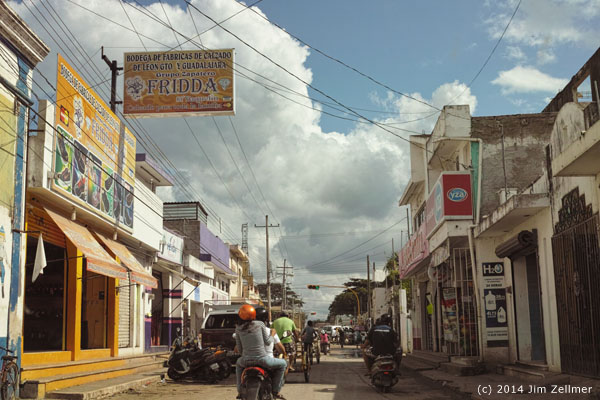
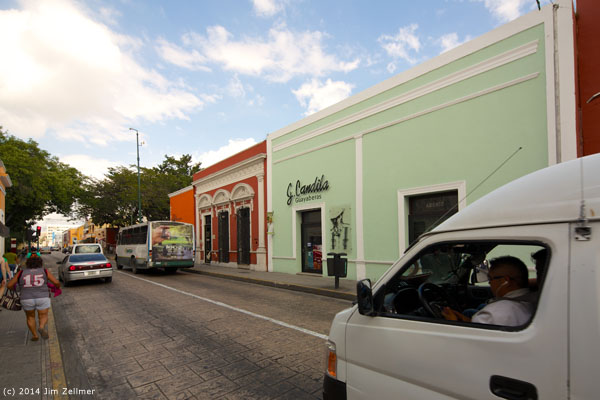
Sydney. Vienna. Paris. Santa Cruz. Twin Valley. Charlotte. Johannesburg. San Diego. New York. Home to just a few of the fellow travelers I met while driving through the Yucatan Peninsula recently. Travel is a blessing to be savored.
But it was the Pemex gas station attendant whose friendly Spanish and English words remained with me as I queued with paperwork to return my rental car.
Pemex, Mexico’s national oil company, will soon lose its monopoly status likely changing their auto service culture.

I pondered this while visiting several Pemex facilities over the past few weeks. Not that I had an opportunity to choose other brands, much less price shop petrol. I noticed just one non-Pemex station during our 1360km journey.
I often saw full service attendants standing next to fuel pumps when arriving at a Pemex station. In one case, a bit of competition broke out as our non-swift Nissan rental pulled into the station. Two attendants waved and urged me to choose their pump. I chose the left pump.
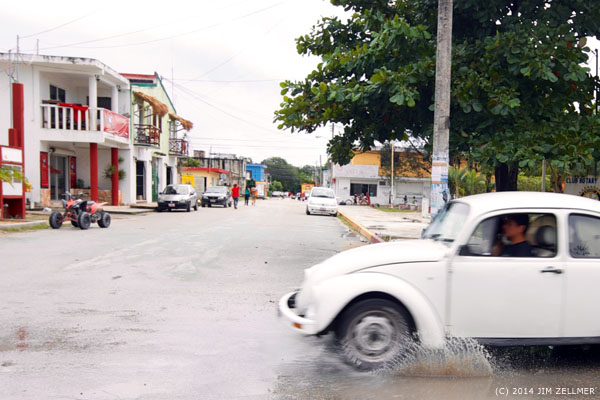
The attendants sometimes wash your windshield (mosquito detritus) unprompted, though in larger cities, street entrepreneurs, as in the USA, dart between cars when stopped at an intersection and do the job using a presumptive close.
In all cases, I was urged to pay cash.
We further managed to communicate our need for air in the tires, twice.
One of the attendants responded warmly to our somewhat serviceable Spanish. He mentioned (Spanish & English) with a big smile that while working in a US hotel in 1970, “no one spoke Spanish, no one knew anything about our culture”. “Today, many people speak Spanish, people love our food, culture, the salsa“.
He warned us to make sure that Pemex attendants start the petrol pump at 0 and wished us a joyous journey.
Full service gas station nostalgia explored the deeper recesses of my mind, bringing back memories of a largely lost business. Riding with parents and grandparents while they filled up generally included a bit of time sharing the latest with the attendants while they looked over the car. Full service stations fueled your car, washed your windshield, checked the engine oil and tire pressure. These stations often performed maintenance as well.
In many countries fuel stops today serve as an appetizer for 7-11 style retail businesses featuring a plethora of high margin fast food and road related products.
It had been too long since I visited Mexico. Our journey could not have been more interesting, relaxing and enjoyable. Where might our Pemex oracle might find himself in ten years time?
Related: Daniel Yergin: Behind Mexico’s Oil Revolution.