The Calendar I’d seen on previous Permissions, and the Calls (while annoying) I’m pretty sure had been there too. But check out the exact wording of the SMS/MMS Permission, and that of the Contacts one.
Doesn’t that alarm you as a user? Read that wording again, especially this statement:
This allows the app to read all SMS messages, regardless of content or confidentiality.
Wow. Just… wow. Not even my wife gets access to my SMS messages (and no, Jacki, I have nothing to hide!). What honest and useful reason can Facebook have to get access to my texts? Seemingly they’re running with the “It will help us target better” message.
Author: Jim Zellmer
The Financial Vulnerability of Americans
Excessive household debt was crucial in explaining the severity of the Great Recession. So where are we now? Have households strengthened their financial position since 2009? Are household balance sheets strong enough to prevent another massive pull back in spending if there are significant job losses?
To answer to these questions, we look at evidence from the 2012 National Financial Capability Study by FINRA. (We are grateful to Annamaria Lusardi, an expert on financial literacy, for pointing us to the data used in this post.) This survey is a representative sample of 25,000 individuals who were asked mostly qualitative questions about their finances. The survey was put into the field three years after the worst of the Great Recession.
The survey responses are shocking, and should put fear into all of us about the financial vulnerability of U.S. households.
A messy legacy: Lawrence in Arabia
Lawrence of Arabia is one of those figures, like Mahatma Gandhi, who tends to generate biographies more or less every year. With the centenary of the First World War already upon us – and with the anniversary of Lawrence’s Arab Revolt in 2016 – Scott Anderson’s gripping new study, subtitled War, Deceit, Imperial Folly and the Making of the Modern Middle East, is only the forerunner of what is likely to be a very long caravan of new Lawrence books to come lolloping over the desert horizon over the next couple of years. Anderson’s version of the story is a brilliantly pulled-off piece of narrative history that demonstrates both why Lawrence continues to grip our imagination and why he can be a deeply problematic lens through which to examine the tensions of the Middle East.
At the time, Lawrence’s dashingly cinematic raids on the Hejaz railway and his camel-borne attacks on Wejd and Aqaba during the First World War were regarded, as Lawrence wrote, as “the sideshow of a sideshow”. All eyes were on Ypres and the trenches of the Somme, where half the youth of Europe were being slaughtered on the Western Front. But the desert campaigns have become as iconic as they are because Lawrence provides a familiar face with which historians and biographers can tell one of the most complex and important stories of the war: the tale of the break-up of the Ottoman empire and the creation of the ongoing political train crash that is the modern Middle East.
For it is Lawrence’s eastern theatre that has left by far the more important and messy legacy of that war. It is a legacy that we are still trying to contain today as Egypt undergoes its multiple revolutions and counter-revolutions, as Syria burns, as Israel remorselessly settles Palestinian land and as the Palestinians displaced in 1948 continue to rot in refugee camps.
America’s democracy is fit for the 1 per cent
America was forged in opposition to the aristocratic corruption of Europe. Today, inherited wealth is more entrenched in the US than it is in almost every corner of the old world. So too are legacy places at Ivy League universities that were once such wellsprings of US meritocracy.
Today, inherited wealth is more entrenched in the US than it is in almost every corner of the old world
In politics too, dynasty has rarely been more entrenched. It would be little surprise were the 2016 election to turn into a contest between Hillary Clinton and Mr Bush. Seven of the past nine presidential elections have featured a member of the Bush or Clinton families. Next time could make it eight out of 10.
Both families benefit hugely from the networks of donors they have cultivated over the decades. It goes without saying that their donors have done pretty well too. The story continues. George P Bush, Jeb’s son, is running for land commissioner in Texas. Many believe Mrs Clinton’s daughter, Chelsea, is preparing the ground for her own future in US politics.
Of course, dynasty is not only about money. In a celebrity-driven age it also brings valuable name recognition. Moreover, money is not enough on its own to change election outcomes. The infamous Koch brothers, Charles and David, who own the second-largest private corporation in the US, spent tens of millions on the 2012 presidential without avail – as did Mr Adelson. And US democracy is still capable of extraordinary upsets, notably Mr Obama’s emergence from nowhere to dislodge Mrs Clinton in 2008.
TV Circa 2014
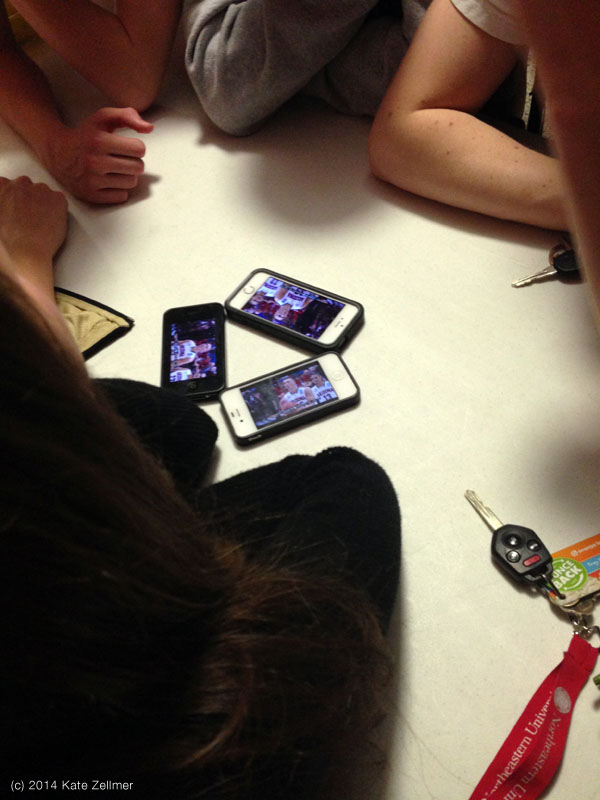
An “awesome” photo of our time by Kate Zellmer. Students watching the NCAA tournament thriller: Arizona vs. Wisconsin via their iPhones.
Ben Thompson reflects on how TV has changed over the years.
“Only 12% of 18-29 year olds said TV would be hard to give up: view the internet, cellphones as essential” – Pew Research.
“Broadcast Audience Older Than Ever Ratings hold up while viewers continue to age out of the demo” – Anthony Crupi.
Commercial break: the first American trade mission to China
Next Saturday marks the 230th anniversary of a small ship setting sail from New York. It was the 52nd birthday of George Washington, the man who five years later would become the first president of the United States, and as that little ship set off down the East River, past a 13-gun salute, it set in motion a commercial relationship that is now the most critical in the global economy.
The Empress of China was bound for Canton (Guangzhou) and the first direct contact between America and China. She was to spark a frenzy of maritime trade between the two nations.
These days, every nuance that might represent a commercial or geopolitical change in the relationship between the US and China is eagerly reported by the world’s media, though on that chilly Sunday morning in 1784, there was no relationship at all. And over the course of more than two centuries, while the scale of US-China trade has burgeoned beyond any 18th-century imagination – the total trade in goods and services between the US and China stood at US$539 billion in 2011 – the legacies from those early days remain and some of the characteristics are surprisingly similar.
This historic voyage was not inspired by diplomacy or naval prowess, however, but by Americans’ love of tea.
Google Wants E-Mail Scanning Information Blocked
Rommel told Koh that Google made the change after determining that Content Onebox couldn’t extract information from e-mails that hadn’t been opened or deleted, or that were opened on an iPhone or sent through an e-mail provider other than Google.
After the switch to scanning unopened e-mails, Google began creating profiles of people “from which they could extrapolate additional advertisements,” Rommel said, without giving details of how Content Onebox works.
“Google itself has admitted and declared that the location and the timing of Content Onebox’s existence is proprietary, it’s secret, it’s unknown,” Rommel said at the Feb. 27 hearing. “There’s not a single disclosure in the record which identifies that there’s a content extraction feature occurring in the delivery process, which would be the interception.”
You Are Your Own Media Company
Let’s start broadly and just talk about the social media biz. What’s the size of the industry or what kind of money is at stake?
In social media? Well, social media needs content created by the audience. We used to call it UGC in the industry, user-generated content. Now it’s called social media. But user-generated content was a very small market before Twitter. Twitter was really the seminal company here, not Facebook. …
Twitter was the one that enabled everyone to have their say, and of course, all the celebrities came onboard, and that was a real seminal moment as well. … Once those people started getting on, and you realize, “Wow, I’m just one step away, zero hops from a celebrity, and I can reply to them,” that’s when it exploded.
It does change everything, because now the audience is no longer the audience. The audience is now the publisher, and if you’re good, you can really disintermediate the publisher and the news sources and go direct. And once you can go direct, that changes the whole media business. It used to be people who had something to say would go to The Wall Street Journal, New York Times or a magazine, Spin magazine, whatever it is, and they would be interpreted and then presented to the audience. Now, we go direct to the audience, and there’s no filter. …
Does this create just a ridiculous glut of information? How does a young person cut through the clutter?
Why we could be back in a housing bubble right now
Let me preface this note by saying “I am a raging bull over houses”. I love real estate. On any given Sunday you can find me and my family touring open resale houses or new builder communities. My grammar school-aged kids love it too; especially the free cookies and peering into the beautifully staged rooms and really believing that some lucky kid has every gadget or musical instrument ever made and with utter amazement on how clean he keeps his room. Of course, my wife and I fully propagate the lie by saying “did you two see how clean the Lennar boy and Pulte girl keep their rooms? Why can’t you do the same?”
I think it’s safe to say that America — especially the American media and Wall Street firms — has fallen in love with real estate again. But, this time around it’s not ‘all of America’ like the last time; when the most exotic mortgage loans known to mankind turned every ma and pa end-user homeowner into a raging speculator. One has to look no further than the generationally low level of purchase loan applications — with rates at generational lows — to realize something isn’t ‘normal’ about this housing market. Rather, controlling this housing market over the past three years has been a small, unorthodox slice of the population that “invests” in real estate using tractor-trailer trucks full of cash-money slopping around the financial system put into play specifically for this purpose. Over the past few years so much cash-money has been deployed into the housing sector by unorthodox parties, that in many regions ma and pa end-user hasn’t stood a chance to buy. Especially, if they need a mortgage loan, which of course presents numerous risks to the seller vs the all-cash buyer.
In part, this is why I believe we could be back in a house-price bubble right now and not even realize it. And also because everybody is looking at the wrong thing…house prices. Sound confusing? It’s not, really.
You’re Drinking the Wrong Kind of Milk
When my in-laws moved from India to the United States some 35 years ago, they couldn’t believe the low cost and abundance of our milk—until they developed digestive problems. They’ll now tell you the same thing I’ve heard a lot of immigrants say: American milk will make you sick.
It turns out that they could be onto something. An emerging body of research suggests that many of the 1 in 4 Americans who exhibit symptoms of lactose intolerance could instead be unable to digest A1, a protein most often found in milk from the high-producing Holstein cows favored by American and some European industrial dairies. The A1 protein is much less prevalent in milk from Jersey, Guernsey, and most Asian and African cow breeds, where, instead, the A2 protein predominates.
“We’ve got a huge amount of observational evidence that a lot of people can digest the A2 but not the A1,” says Keith Woodford, a professor of farm management and agribusiness at New Zealand’s Lincoln University who wrote the 2007 book Devil in the Milk: Illness, Health, and the Politics of A1 and A2 Milk. “More than 100 studies suggest links between the A1 protein and a whole range of health conditions”—everything from heart disease to diabetes to autism, Woodford says, though the evidence is far from conclusive.