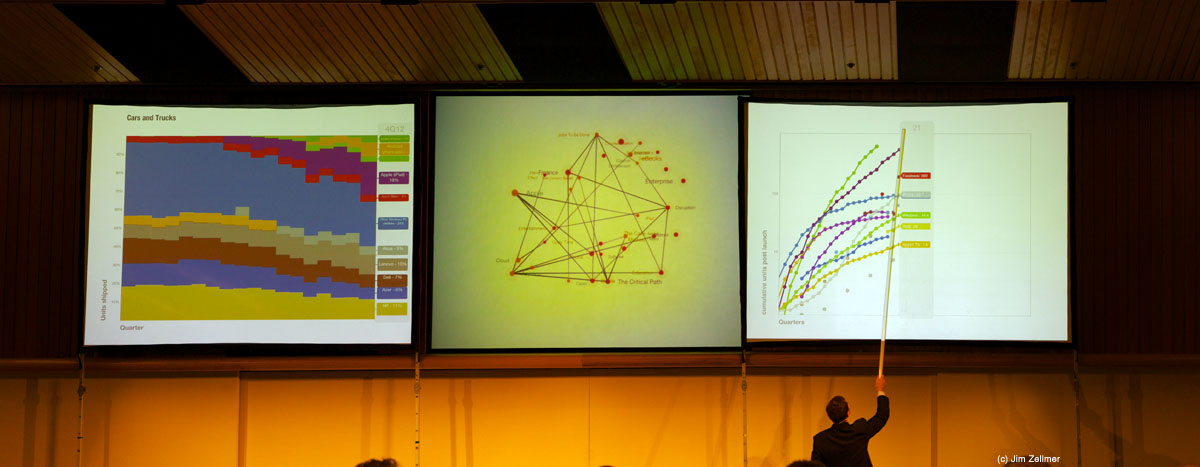
Horace Dediu (asymco.com, interview) reaches for a billion users at Asymconf Silicon Valley 2013.
-
Recent Posts
-
Archives
-
More Info

Horace Dediu (asymco.com, interview) reaches for a billion users at Asymconf Silicon Valley 2013.
For almost a century, the world of economics and finance has been dominated by randomness. Much of modern economic theory describes behaviour by a random walk, whether financial behaviour such as asset prices (Cochrane (2001)) or economic behaviour such as consumption (Hall (1978)). Much of modern econometric theory is likewise underpinned by the assumption of randomness in variables and estimated error terms (Hayashi (2000)).
But as Nassim Taleb reminded us, it is possible to be Fooled by Randomness (Taleb (2001)). For Taleb, the origin of this mistake was the ubiquity in economics and finance of a particular way of describing the distribution of possible real world outcomes. For non-nerds, this distribution is often called the bell-curve. For nerds, it is the normal distribution. For nerds who like to show-off, the distribution is Gaussian.
The normal distribution provides a beguilingly simple description of the world. Outcomes lie symmetrically around the mean, with a probability that steadily decays. It is well-known that repeated games of chance deliver random outcomes in line with this distribution: tosses of a fair coin, sampling of coloured balls from a jam-jar, bets on a lottery number, games of paper/scissors/stone. Or have you been fooled by randomness?
In 2005, Takashi Hashiyama faced a dilemma. As CEO of Japanese electronics corporation
Maspro Denkoh, he was selling the company’s collection of Impressionist paintings, including pieces by Ce?zanne and van Gogh. But he was undecided between the two leading houses vying to host the auction, Christie’s and Sotheby’s. He left the decision to chance: the two houses would engage in a winner-takes-all game of paper/scissors/stone.
Recognising it as a game of chance, Sotheby’s randomly played “paper”. Christie’s took a different tack. They employed two strategic game-theorists – the 11-year old twin daughters of their international director Nicholas Maclean. The girls played “scissors”. This was no random choice. Knowing “stone” was the most obvious move, the girls expected their opponents to play “paper”. “Scissors” earned Christie’s millions of dollars in commission.

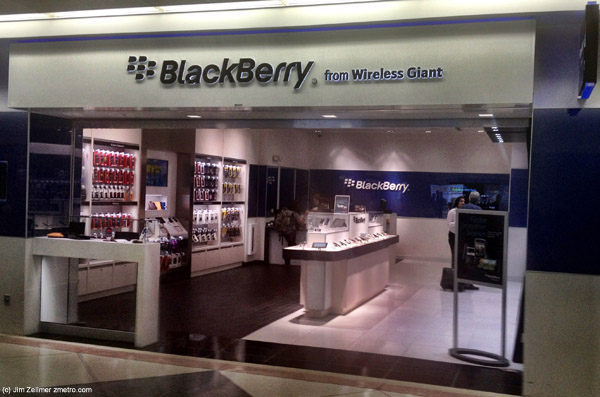
I snapped this photo in Charlotte while quickly changing planes recently. Its presence caused me to do an about face as I had not previously seen a Blackberry branded retail store – nor did I ever expect to encounter such a place.
RIM was once a high flyer, but, via this informative Horace Dediu chart, has been unable to address the iPhone led smartphone disruption.
Black Swan Theory.
Brian S. Hall has been following the Smartphone wars for some time.
A quick primer on what naked short selling is. First of all, short selling, which is a completely legal and even beneficial activity, is when an investor bets that the value of a stock will decline. You do this by first borrowing and then selling the stock at its current price, then returning the stock to your original lender after the price has gone down. You then earn a profit on the difference between the original price and the new, lower price.
What matters here is the technical issue of how you borrow the stock. Typically, if you’re a hedge fund and you want to short a company, you go to some big-shot investment bank like Goldman or Morgan Stanley and place the order. They then go out into the world, find the shares of the stock you want to short, borrow them for you, then physically settle the trade later.
But sometimes it’s not easy to find those shares to borrow. Sometimes the shares are controlled by investors who might have no interest in lending them out. Sometimes there’s such scarcity of borrowable shares that banks/brokers like Goldman have to pay a fee just to borrow the stock.
These hard-to-borrow stocks, stocks that cost money to borrow, are called negative rebate stocks. In some cases, these negative rebate stocks cost so much just to borrow that a short-seller would need to see a real price drop of 35 percent in the stock just to break even. So how do you short a stock when you can’t find shares to borrow? Well, one solution is, you don’t even bother to borrow them. And then, when the trade is done, you don’t bother to deliver them. You just do the trade anyway without physically locating the stock.
IT WAS the Apple of its era. Just like the late Steve Jobs with computers and music-players, George Eastman (pictured below behind the camera, with Thomas Edison) did not invent the camera and photographic development. But he simplified the technology. He outmaneuvered rivals. And he marketed his products in novel ways.
Yet the empire Eastman started to build at the end of the 19th century, and which dominated the 20th, did not last long into the 21st century. On January 18th Eastman Kodak filed for Chapter 11 bankruptcy protection in New York. The firm was laid low by the rapid shift to digital photography and away from film, where Kodak once earned 70% margins and enjoyed a 90% market share in America.
These handsome profits meant that the firm could invest huge sums in research and development. Yet ironically, extensive R&D contributed to Kodak’s undoing, since the firm ended up pioneering the very digital cameras that went on to kill its core business. The profits also allowed Kodak to be a generous and caring company for generations of employees in Rochester (New York), where it is based, and beyond. This, too, added to its troubles, since its pension obligations left it with less capital to diversify or invest in promising areas that might have saved it.
Before prohibition the seaside landscape of beer was flourishing. Variety was truly the spice of life, and every locale had its own. Styles traveled from the old world, and were enjoyed in the new. Then the 21st amendment happened, and the fields were burned, and salted. A once flourishing industry was destroyed, and all that remained was a weakened few. Before the microbrew revolution, 3 players came to dominate the entire empire. The feudal consumer was left to choose between three piss colored lagers all tasting exactly the same. They obtained these thrones through a brutal war. Expensive marketing budgets boasted a generic flavor that was at best, not offensive. As large corporations tend to do, the players got big, and they earned power. They used this power to influence policy in an effort to maintain their oligopolistic positions.
It’s hard for me not to draw parallel lines between Hollywood today, and big beer. Today only 6 studios produce nearly the entirety of our big screen entertainment. Much like beer they rely on marketing to drive their product. A script can be great, but if a studio can’t find a sure way to market it, it’s dead. The result is a series of the same movies over and over again. We put up with these movies, because when we go to the theatres, much like the bars of yesterday… there just aren’t any other choices. There is something happening though. The home-brewers are starting to talk to each other!
The technology industry might be crucial for the economy of Wisconsin’s second-largest city, but our congressional delegation has been reluctant to heavily contribute to the debate about SOPA and PIPA. It took until Wednesday’s online “blackout,” in which The Badger Herald participated, for Madison’s own Democratic Rep. Tammy Baldwin to release a statement announcing she would not support the legislation.
Last Tuesday, Baldwin’s press representative said she had “some reservations” about the legislation. Baldwin still was staying unusually quiet about the issue.
Baldwin has rightfully earned her title as one of the most effective progressive voices in the House of Representatives. However, her reluctance to be one of the major progressive voices to come out early against SOPA and PIPA exposes several important aspects of her position in Congress, her campaign for Senate and the disappointing representation of Congress’ Democratic caucus.
Ever since her first Congressional victory in the 1990s, Baldwin has essentially been a shoo-in to win Wisconsin’s 2nd Congressional District. Still, she needs donations to keep her biannual campaigns afloat, and she predictably receives large donations from trade unions and equal rights advocacy groups.
A brief scan of the history of donations to Baldwin’s campaign committee might explain her reluctance to oppose SOPA immediately. In 2010, the National Cable and Telecommunications Association donated $10,000 to Baldwin’s campaign, tying it with three other unions as the top donor to the Baldwin campaign. Unsurprisingly, the NCTA is one of the many organizations affiliated with the entertainment industry that supports SOPA.
It’s hard to wrap your head around the size and complexity of the gearhead Mecca, the Nürburgring. Made by the people at Carbuzz UK, this is all the info you need to prepare yourself for your next Bridge-to-Gantry Hajj.
When an English journalist visited the track for its opening race in 1928 he remarked, “it seemed as if a reeling, drunken giant had been sent out to determine the route.” If that alone doesn’t make you want to get out to the longest permanent racetrack in the world, then this visual breakdown of all of its narrow, twisting, deadly glory will.
ACG 5 Peter Schneider – The American Council on Germany, Keynote Speaker, “Reinventing the Industrial Heartland” from Tracy Will on Vimeo.
I enjoyed Schneider’s October talk. Here’s his Wikipedia entry, and website.